
TL;DR — Quick Summary
Spring tree care tips every Vancouver homeowner needs. When to prune, mulch, and call an ISA-certified arborist. Free estimates: (604) 721-7370.
Spring tree care tips don't get enough attention. Most homeowners wait until something looks wrong. By then, the problem is already bigger than it needs to be.
In Vancouver, spring is a critical window. Lower Mainland winters are wet and windy. Trees take real damage between November and March. When spring arrives — usually late February through April — that's your chance to catch problems and fix them before summer.
We've assessed and cared for thousands of trees across Vancouver, Burnaby, North Vancouver, Coquitlam, and Richmond. Here's what we see every spring, and exactly what you should do about it.
TL;DR
- **Start your spring inspection in late February** — not April. Early detection saves trees and money.
- **Prune spring-blooming trees after they flower.** Prune everything else before buds open.
- **Mulch 3–4 inches deep, 3–6 inches away from the trunk.** Volcano mulch kills trees. Keep it off the bark.
- **Vancouver's Private Tree Bylaw (No. 9958) applies year-round.** Trees 20 cm DBH or larger need a permit before removal — regardless of the season.
- **Call an ISA-certified arborist for anything requiring a ladder, a chainsaw, or a permit.** WorkSafeBC consistently identifies tree and chainsaw-related incidents as among the highest-severity injuries in BC's landscaping sector.
---
When Is the Right Time to Start Spring Tree Care in Vancouver?
Don't wait for warm weather. Start in late February.
Vancouver winters are unusually wet. Fungal infections, root rot, and bark disease thrive in that moisture. By the time most homeowners notice visible damage, problems have been building for weeks — sometimes months.
The City of Vancouver's Urban Forest Strategy (updated 2023) identifies storm damage and disease as two of the top causes of urban tree decline. Vancouver manages approximately 154,000 street trees. Private property trees face the same seasonal stresses without a city maintenance crew checking on them.
Here's what to do in late February and early March:
- Walk your property after any major windstorm
- Look for hanging or cracked branches — arborists call these "widow makers" because they fail without warning
- Check the base of the trunk for cracks, heaving soil, or mushroom growth
- Note any lean that wasn't there last fall
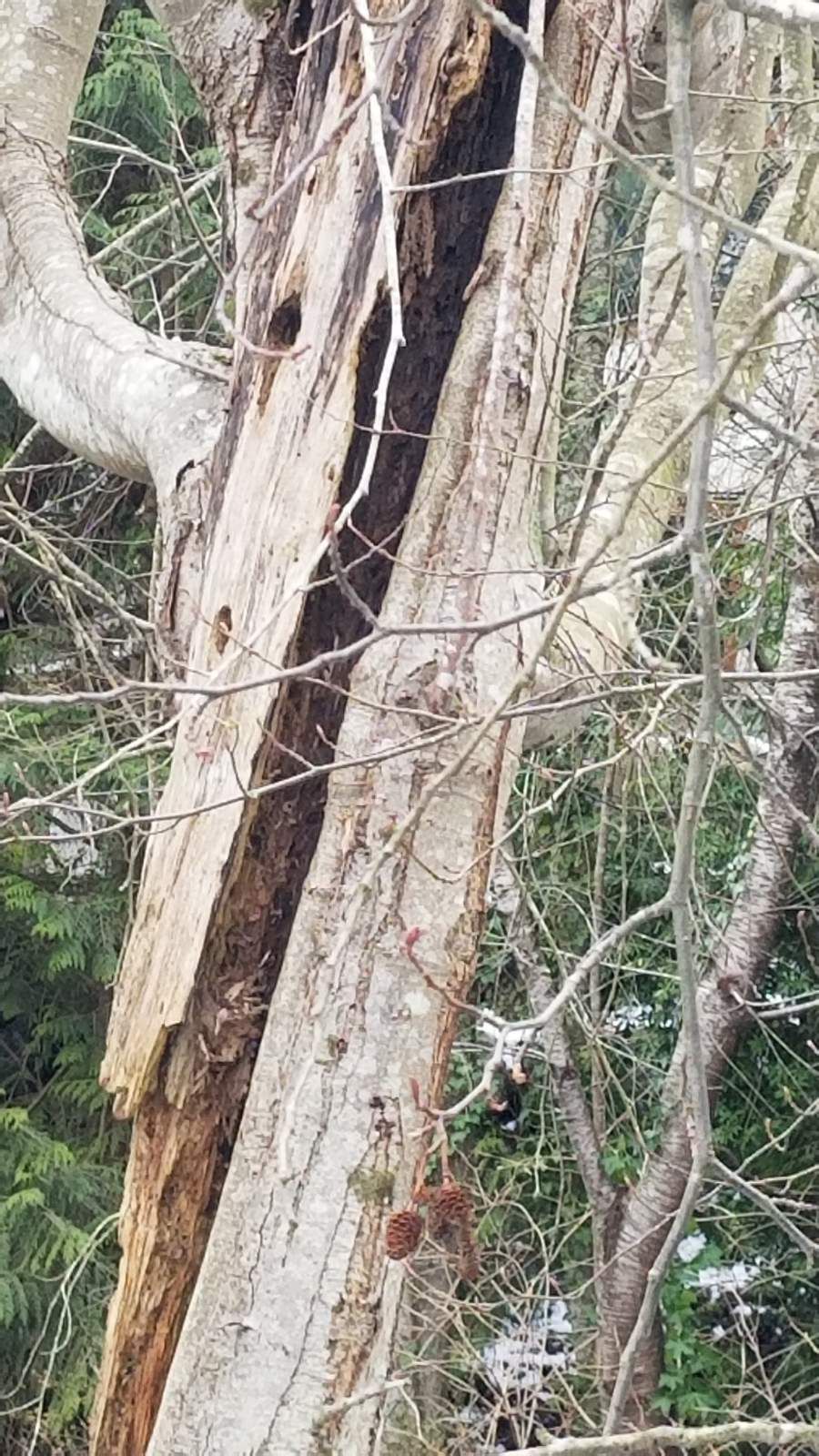
If you see any of these signs, don't start pruning. Call a certified arborist first. A leaning tree after a storm isn't a pruning job — it may be a full hazard assessment situation.
---
How Do You Inspect a Tree After a Vancouver Winter?
A proper post-winter inspection takes about 15 minutes per tree. Work from the ground up.
**Start at the root flare.** That's where the trunk meets the soil. It should be slightly visible. If it's buried, that's a problem. Look for:
- Heaving soil around the base (sign of root movement)
- Mushrooms or conks growing at or near the base (sign of internal decay)
- Exposed roots that weren't visible last year (often from erosion)
**Move up the trunk.** Scan from the root flare to the first major branch junction. Look for:
- Vertical cracks in the bark
- Bark falling off in large sheets (arborists call this "sloughing")
- Dark staining or oozing — often a bacterial condition called "wetwood" or "slime flux"
- Cavities that appear larger than last season
**Then assess the canopy.** Dead branches in the upper crown are easy to miss until one lands on your fence. Check for:
- Branches that didn't leaf out last spring
- Crossing or rubbing branches (they create wounds that invite disease)
- Cracks at the branch collar — the raised ring where a branch meets the trunk
Not sure what you're looking at? An arborist report from an ISA-certified professional gives you a written assessment you can act on. It's also required for most City of Vancouver permit applications.
---
Which Trees Should You Prune in Spring — and Which Ones Should You Wait On?
Pruning at the wrong time can cause real damage. The right timing depends entirely on the species.
**Spring-blooming ornamentals** — cherries, plums, magnolias — set their flower buds the previous fall. Prune them in March and you cut off this year's blooms. Wait until after the flowers fade, then prune.
**Most other trees** should be pruned in late winter, before buds open. In Metro Vancouver, that's roughly late February to mid-March. Dormant-season pruning means lower sap flow, fewer wounds exposed during peak pest season, and faster healing. Douglas fir, Western red cedar, Big-leaf maple, and fruit trees all fit this window.
**ANSI A300 standards** set the accepted benchmark for professional tree pruning in North America. Published by the American National Standards Institute, they specify:
- Remove no more than 25% of a tree's living canopy in a single growing season
- Cut just outside the branch collar — never flush with the trunk
- Never "top" a tree by cutting off the entire upper crown
Topping is still common in residential settings. It's not just poor practice — it produces multiple weakly attached regrowth stems and significantly increases the risk of branch failure over time. A tree that's been topped is structurally compromised for decades. If a contractor suggests topping, that's your signal to call someone else.
For precise tree cutting and crown management done to ANSI A300 standards, our ISA-certified team handles everything from selective pruning to full crown restoration.
---
Why Does Mulching Matter More Than Most People Think?
Mulch might be the single highest-return thing you can do for your trees in spring. And most homeowners either skip it or do it wrong.
The "volcano mulch" mistake — piling mulch right against the bark — traps moisture against the trunk, promotes fungal rot, and creates habitat for bark-boring insects. It's extremely common and genuinely harmful. Trees die from this every year.
The right way: apply 3 to 4 inches of wood chip mulch in a ring around the tree. Start 3 to 6 inches away from the trunk. Extend the ring as far as the drip line if you can.
**Why it works:**
- Retains soil moisture during Vancouver's dry July and August
- Moderates soil temperature through spring heat spikes
- Suppresses weeds that compete for water and nutrients
- Breaks down over time into organic matter that feeds the root zone
Research published by the University of Florida's Institute of Food and Agricultural Sciences found that properly applied mulch can reduce soil moisture loss by up to 70%. In a city where summers are getting drier and longer, that matters.
Use arborist-grade wood chips — not dyed decorative bark. Wood chips break down and improve your soil. Dyed bark often doesn't, and some commercial dyes can affect soil biology.
We provide professional mulching with arborist-grade wood chips. It's one of the most practical investments in long-term tree health.
---
What Spring Pests and Diseases Should Vancouver Homeowners Watch For?
Spring is when pest populations explode. By the time you see damage, infestations are usually already well established.
**Western tent caterpillar** is one of the most visible spring pests in the Lower Mainland. These caterpillars build white silk tents in the branch forks of ornamental cherry, alder, and Pacific crabapple. They defoliate entire branches fast. Small nests can be removed by hand. Larger infestations need professional treatment.
**Bronze birch borer** is a serious threat to birch trees across Metro Vancouver. Adults emerge in May and lay eggs under the bark. The larvae tunnel through the vascular tissue, eventually cutting off water and nutrient flow. Signs include D-shaped exit holes in the bark, dieback starting at the crown tips, and yellowing foliage from the top down. By the time you see those signs, significant internal damage has already occurred.
**Cytospora canker** is a fungal disease that attacks stressed trees — especially Prunus species (cherries, plums) and poplars. It creates sunken, discolored areas in the bark that ooze amber gum. It enters through wounds. This is exactly why ANSI A300 cutting technique matters: clean cuts that heal properly are your first line of defence against fungal entry.
**Phytophthora root rot** thrives in Vancouver's wet clay soils. Symptoms include yellowing leaves, early leaf drop, and overall decline that's often mistaken for drought stress. It's caused by a water mold that builds up in poorly drained, saturated soil — especially after a wet winter.
**Sudden oak death** (Phytophthora ramorum) has been documented in BC's nursery trade and in the Lower Mainland. The BC Ministry of Agriculture has mandatory reporting protocols for suspected cases. While it primarily devastates tanoak in California, it can infect over 100 plant species — including rhododendron, one of the most common shrubs in Vancouver gardens.
An experienced arborist catches these problems early. Early-stage intervention costs far less than tree removal.
---
What Are the Warning Signs That a Tree Needs a Professional Right Away?
Some spring tree care is absolutely homeowner-appropriate. Raking debris, applying mulch, watering during dry spells — those are yours to handle.
But some signs mean you should step back and call a professional.
**Call an arborist if you see:**
- Any cracked, hanging, or dead branch greater than 10 cm in diameter
- A new lean toward a structure — especially after a windstorm
- Bark damage that exposes the white wood (cambium layer) beneath
- More than 30% of the canopy showing dead or dying branches
- Any tree touching or within 2 metres of a power line — BC Hydro requires ISA-certified arborists for utility-adjacent tree work
- Root damage from construction or excavation within the tree's drip line
- Visible decay at the trunk base after any significant storm
**The one-third rule:** A tree that loses more than a third of its living canopy — from storm damage, disease, or improper pruning — is under severe physiological stress. Its capacity to photosynthesize and feed its root system drops sharply. Structural problems follow.
Don't wait. An emergency tree service call costs a fraction of what a fallen tree on your roof, fence, or vehicle does. Address hazards before they fail.
---
Do You Need a Permit to Remove or Prune a Tree in Vancouver in Spring?
Yes — and this catches homeowners off guard every year.
The City of Vancouver's Private Tree Bylaw (No. 9958) protects trees on private property that meet these criteria:
- DBH (diameter at breast height, measured at 1.4 metres above grade) of 20 cm or greater for most species
- DBH of 50 cm or greater for fruit trees and certain other species
- All boulevard trees, regardless of size — these are City property
You cannot remove a protected tree without a permit. This applies year-round — spring is not exempt. Pruning that removes more than 25% of a protected tree's crown may also require approval.
As of 2025, permit applications typically require photographs, measurements, and in many cases a certified arborist report. Review timelines vary.
**Other Lower Mainland municipalities have similar requirements:**
- Burnaby requires permits for trees over 15 cm DBH on private property
- City of North Vancouver and District of North Vancouver both maintain tree protection bylaws with their own DBH thresholds
- Richmond and Coquitlam regulate by species and lot type
Not sure if your tree qualifies as protected? We assess trees across the Lower Mainland and help homeowners determine what permits are required before any work begins.
When removal is necessary — whether for safety, disease, or site redevelopment — we manage the permit process, perform the tree removal, and handle the stump grinding afterward.
---
How Does Spring Tree Care Affect Your Property Value Over Time?
This question doesn't come up until people are ready to sell. It should come up much earlier.
Mature trees in good condition add real, measurable value to Metro Vancouver properties. A 2020 study by the US Forest Service (Pacific Northwest Research Station) found that healthy mature trees add between 3% and 15% to property values in comparable urban settings. The effect is strongest for trees with well-maintained canopies.
Trees Canada — Canada's primary national urban forestry organization — published estimates in 2022 showing that a single mature street tree delivers environmental and social benefits worth $500 to $3,000 per year in Canada. Those benefits include stormwater interception, air cooling, carbon sequestration, and reduced runoff.
A neglected tree works against you. Dead branches, fungal decay, and untreated pests compound over years. By the time visible decline is obvious, structural integrity is often already compromised. And removal plus stump grinding is significantly more expensive than the preventive care that could have extended the tree's life by decades.
Spring is the cheapest time to catch problems. A well-timed pruning cut, a properly applied mulch ring, an early pest diagnosis — these are investments, not just maintenance tasks.
---
Is It Worth Hiring a Professional for Spring Tree Care, or Can You DIY?
Honest answer: some of it, yes. Most of it, no.
**Safe to do yourself:**
- Raking dead leaves and debris from the root zone
- Applying wood chip mulch (keeping it away from the bark)
- Watering during dry spells
- Removing small suckers growing from the base of the trunk by hand
- Picking off small tent caterpillar nests you can reach safely from the ground
**Not safe to DIY:**
- Any pruning requiring a ladder or any climbing
- Removing branches over 5 cm in diameter
- Any work near a power line or structure
- Diagnosing pest or disease problems — misdiagnosis leads to wrong treatment
- Assessing structural integrity after storm damage
- Any work on a tree that requires a City permit
Chainsaw injuries and falls from ladders are among the most serious risks in residential tree work. WorkSafeBC consistently identifies tree and chainsaw-related incidents as some of the highest-severity injuries in BC's landscaping and arboriculture sector. Most occur outside professional work settings.
Beyond physical safety: improper pruning cuts create entry points for disease. That damage doesn't show up for 5 to 10 years — slowly, quietly, expensively.
We're ISA-certified and WCB registered. That means our arborists train to current industry standards and you're protected if anything unexpected happens on the job.
If you want to understand what certified credentials actually mean and what questions to ask before hiring, our guide to finding qualified arborists in Vancouver walks through exactly that.
---
What About Hedges — Do They Need Spring Attention Too?
Absolutely — and they're often the most overlooked part of spring property care.
Hedges in the Lower Mainland take real winter abuse. Frost damage on outer foliage, wind burn, and fungal spotting are common by March. The instinct is to prune hard and start fresh. Resist it.
Wait until new growth begins — usually April in Vancouver — before doing significant shaping. Pruning into dead wood before you can see where live growth starts risks cutting too deep. You'll end up with bare patches that take a full season to recover.
For formal hedges — cedar, boxwood, cherry laurel — light shaping after the first flush of new growth gives a cleaner finish than pruning dormant stems. For informal hedges, remove dead or diseased material in late winter, then shape once new growth arrives in April or May.
Professional hedge trimming is one of our most common spring requests. Done correctly, a well-trimmed hedge holds its shape all summer without needing repeated touch-ups through the growing season.
---
FAQ
**Q: When is the best time to prune trees in the Vancouver area?**
A: For most trees, late February to mid-March is ideal — before buds open and sap flow increases. Spring-blooming ornamentals like cherry, plum, and magnolia should be pruned after their flowers fade, not before. Avoid heavy pruning in summer — heat stress and active insect populations make wounds harder to close cleanly.
**Q: Do I need a permit to remove a tree on my own property in Vancouver?**
A: Yes, for protected trees. The City of Vancouver's Private Tree Bylaw (No. 9958) requires a permit before removing trees with a DBH of 20 cm or more on private property. Boulevard trees cannot be touched without City approval. Violations can result in significant fines. Other Lower Mainland municipalities — Burnaby, North Vancouver, Richmond, Coquitlam — have their own bylaws with varying thresholds. Check your specific municipality before any removal.
**Q: What does an ISA-certified arborist check for in a spring inspection?**
A: A certified arborist assesses root flare health, trunk bark integrity, branch attachment angles and structural soundness, signs of fungal disease or active pest infestations, and the overall risk level of the tree. They issue a written arborist report when needed — required for City permit applications, development permits, and many home insurance claims related to tree damage.
**Q: Why is my tree dying from the top down?**
A: Top-down dieback usually signals a vascular problem — root damage from excavation, girdling roots, bronze birch borer activity, or a fungal canker blocking the movement of water and nutrients through the tree. Pruning dead branches doesn't fix the underlying cause. Get a proper diagnosis from an ISA-certified arborist before removing anything.
**Q: What's wrong with piling mulch against my tree trunk?**
A: Piling mulch against the trunk — the classic "volcano mulch" pattern — traps moisture against the bark, promotes fungal decay, and provides cover for bark-boring insects. Over several years, it can kill even a healthy tree. The correct technique is to keep mulch 3 to 6 inches away from the trunk while spreading it outward in a wide, flat ring extending toward the drip line.
---
Spring Is a Short Window. Don't Miss It.
The work you do between late February and May sets your trees up for a healthy growing season — or leaves problems to compound through summer and fall.
Aesthetic Tree & Hedge Services serves Vancouver, Burnaby, North Vancouver, Richmond, Coquitlam, and the surrounding Lower Mainland. Our ISA-certified arborists and WCB-registered crew handle spring inspections, pruning, hazard assessments, arborist reports, full removals, and stump grinding.
**Call us for a free estimate: (604) 721-7370**
ISA-certified. WCB registered. We know these trees.
Found this helpful? Follow our tree care insights directly on Google.
Make us your preferred source on GoogleBefore You Go
Where are you in your tree care journey?
Our Tree Care Services
ISA-certified arborists serving Greater Vancouver
Explore Our Tree Care Services
From expert pruning to safe tree removal, our ISA-certified arborists are ready to help across Greater Vancouver.
View Services