
ISA-Certified Arborists · Greater Vancouver
Tree Service
Richmond
ISA-Certified Arborists · Metro Vancouver
Aesthetic Tree & Hedge Services provides professional tree removal, pruning, stump grinding, hedge trimming, and arborist reports across Richmond, BC. Situated entirely on Lulu Island and Sea Island in the Fraser River delta, Richmond presents unique tree care challenges — flat terrain at or below sea level, a high water table, clay and peat soils, and rapid residential development that brings mature trees into close contact with new construction. Our ISA-certified arborists have 20+ years of experience navigating Richmond's Tree Protection Bylaw, Environmentally Sensitive Area designations, and the specific growing conditions of this low-lying coastal municipality. With 100+ five-star Google reviews, we are one of the most trusted tree service companies serving Richmond homeowners and property managers. Call (604) 721-7370 for a free, no-obligation estimate.
What Tree Species Are Most Common in Richmond?
Richmond's geography is unlike anywhere else in Metro Vancouver. The entire city sits on a flat river delta, much of it at or below sea level, protected by a network of dykes along the Fraser River and coastline. The soils range from heavy marine clay to acidic peat, and the water table often sits within a metre of the surface. These conditions favour a specific mix of native and cultivated species that our arborists encounter on a daily basis:
- Western Red Cedar (Thuja plicata) — The most widely planted tree in Richmond, both as standalone specimens and as hedging. Western Red Cedars tolerate Richmond's wet, poorly drained soils better than most conifers. Mature cedars on older Steveston and Broadmoor properties regularly reach 20 to 30 metres and develop wide, heavy canopies that require periodic crown thinning to reduce wind resistance and prevent limb failure.
- Shore Pine (Pinus contorta var. contorta) — A native species particularly well adapted to Richmond's bog and coastal environments. Shore Pines are found throughout the Richmond Nature Park's remnant peat bog ecosystem and in natural areas around Terra Nova. Unlike the taller lodgepole variety found inland, the Shore Pine stays compact and wind-sculpted, rarely exceeding 10 to 15 metres. These trees are ecologically significant and often subject to additional environmental protections.
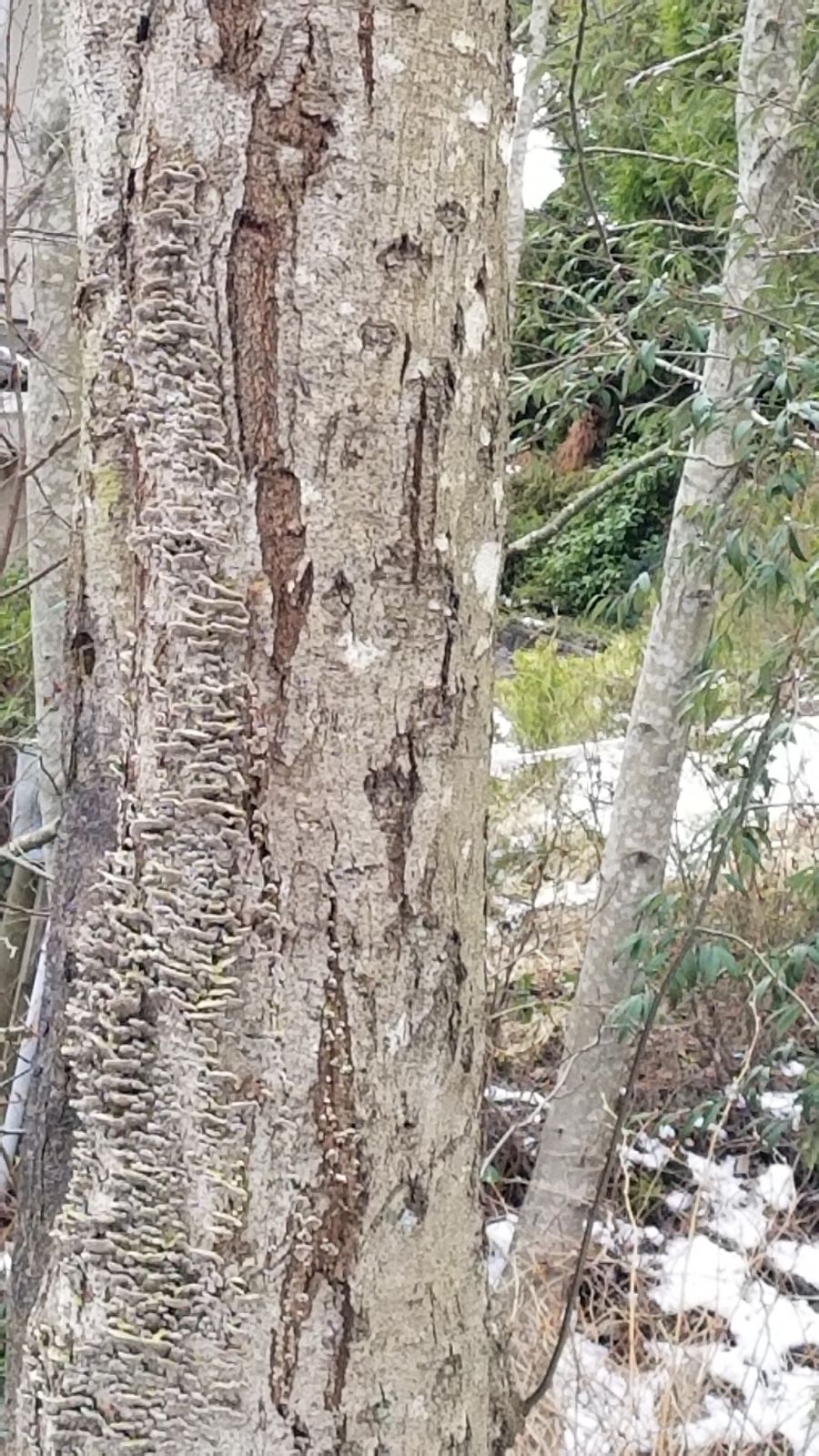
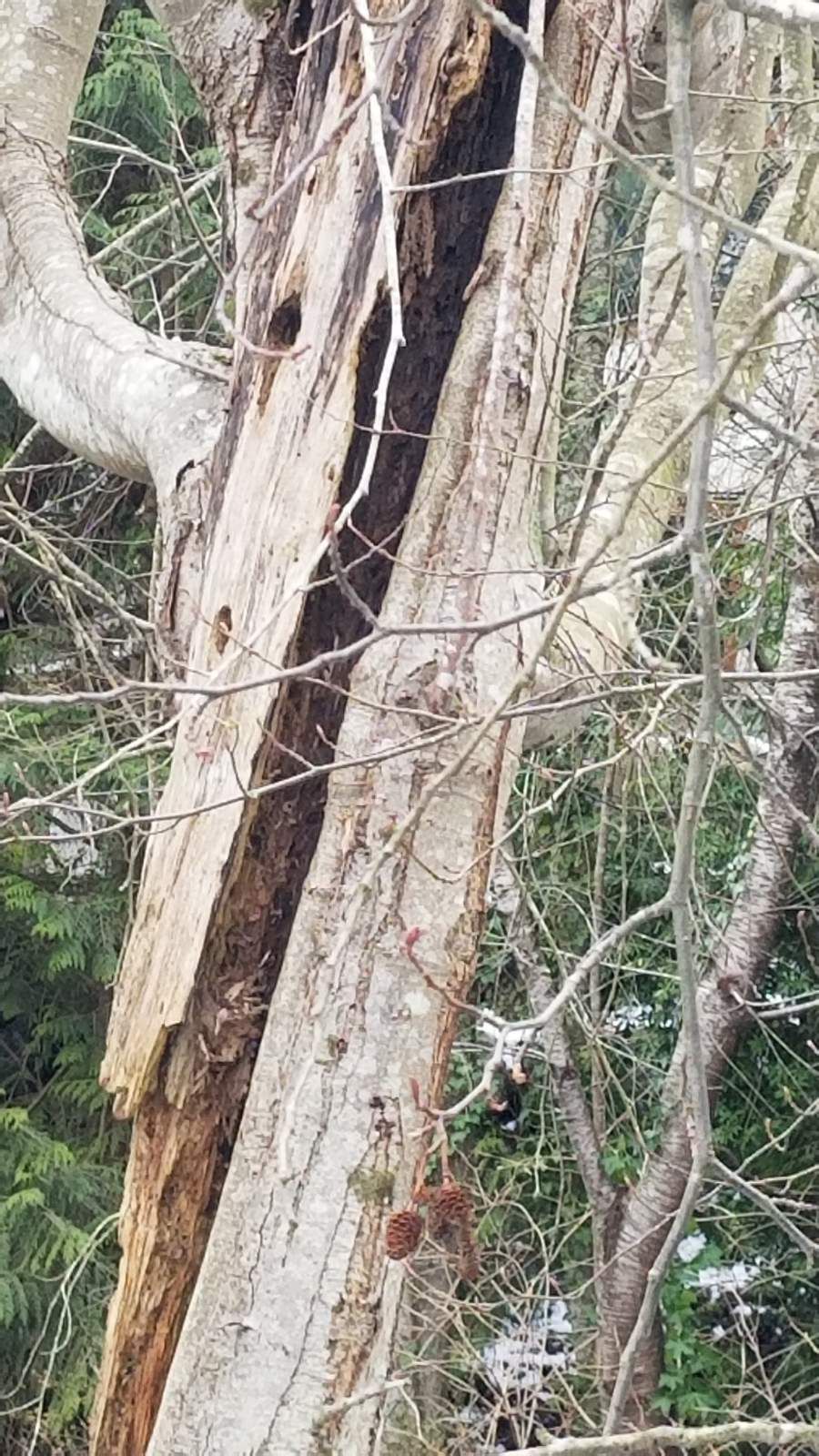
- Red Alder (Alnus rubra) — A fast-growing deciduous pioneer species common along ditches, dyke edges, and disturbed ground throughout Richmond. Red Alders fix nitrogen in the soil and grow rapidly in wet conditions, but they have a relatively short lifespan of 40 to 60 years. Many of the Red Alders planted or naturalized during Richmond's mid-century development are now reaching the end of their lives and requiring removal as they decline and become structurally compromised.
- Black Cottonwood (Populus trichocarpa) — Found along the Fraser River banks, on Lulu Island's perimeter near the dyke trails, and in riparian areas throughout East Richmond and the south arm of the Fraser. Black Cottonwoods are one of the largest native deciduous trees in British Columbia, capable of reaching 30+ metres with massive trunk diameters. They produce enormous volumes of cotton-like seed fluff in spring and have aggressive root systems that can damage foundations, driveways, and underground utilities.
- Japanese Maple (Acer palmatum) — Extremely popular in Richmond's residential gardens, particularly in newer developments across the central corridor, City Centre, and Aberdeen. Japanese Maples are relatively small ornamental trees that rarely require removal but benefit from regular structural pruning to maintain their form and prevent crossing branches.
- Cherry Cultivars (Prunus spp.) — Flowering cherry trees line many Richmond streets and residential properties. Yoshino Cherry (Prunus x yedoensis), Akebono, and Kwanzan varieties are all common. These ornamental trees require attentive pruning to manage canopy shape and prevent storm damage to brittle branches.
The Terra Nova area in northwest Richmond retains significant natural forest cover, including stands of Western Red Cedar, Shore Pine, and Red Alder in a semi-natural coastal setting. The Richmond Nature Park, located at the intersection of Westminster Highway and No. 5 Road, preserves a remnant peat bog ecosystem with a unique assemblage of bog-adapted species including Shore Pine, Labrador Tea, and Sphagnum moss. Trees in and adjacent to these sensitive areas are subject to heightened environmental review before any work can be approved.
How Does the Richmond Tree Bylaw Work?
Richmond's Tree Protection Bylaw No. 8057 regulates the removal, cutting, and damage of trees on private property throughout the city. Understanding this bylaw is essential before starting any tree work on your Richmond property.
Protected Tree Thresholds
Under Bylaw No. 8057, a tree on private property is protected if its trunk measures 20 cm or more in diameter at 1.4 metres above the base (diameter at breast height, or DBH). This threshold applies to all tree species on residential and commercial properties. You cannot remove, cut down, or significantly damage a protected tree without first obtaining a Tree Cutting Permit from the City of Richmond.
Permit Application Requirements
To obtain a Tree Cutting Permit, property owners must submit:
- A completed application form signed by the registered property owner
- A site plan showing the tree's location relative to property lines, buildings, driveways, and neighbouring structures
- An arborist report prepared by an ISA-certified or registered consulting arborist, documenting the tree's species, size, health, structural condition, and the rationale for removal
- A proposed replacement tree plan indicating the species, size, and planting location of replacement trees
The City reviews each application and may attach conditions to the permit, including the species and caliper of replacement trees, the planting timeline, and maintenance requirements for the replacement plantings.
Replacement Tree Requirements
Richmond requires property owners to plant replacement trees after permitted removals. The replacement ratio and specifications depend on the size and species of the removed tree and the characteristics of the property. In general, the City aims for a net-zero or net-positive tree canopy outcome, meaning that the replacement plantings should eventually compensate for the canopy coverage lost by the removal.
Replacement trees must typically be a minimum caliper size at the time of planting and must be maintained for a specified period. Failure to plant or maintain replacement trees can result in enforcement action and additional fees.
Environmentally Sensitive Areas (ESA)
Richmond also designates certain lands as Environmentally Sensitive Areas (ESAs), which include riparian corridors along the Fraser River and its tributaries, wetlands, foreshore areas, and natural habitat zones. Trees within or adjacent to an ESA face additional layers of protection. A Qualified Environmental Professional (QEP) assessment may be required on top of the standard arborist report, and permit conditions may be more restrictive — including seasonal work windows to avoid nesting bird disturbance and enhanced replanting requirements with native species.
Properties near the Fraser River dyke, the south arm shoreline, Terra Nova, and the east Richmond bog areas are most likely to fall within ESA designations. Our arborists can assess whether your property falls within an ESA and guide you through the additional requirements.
Penalties for Non-Compliance
Removing a protected tree without a permit can result in substantial fines under Bylaw No. 8057 and mandatory replacement planting at a higher ratio. The City of Richmond actively investigates complaints about unauthorized tree removal, so it is always best to obtain proper permits before beginning any work.
Aesthetic Tree handles the entire permit process for Richmond property owners, from the initial site assessment and arborist report through to the permit application submission and replacement tree planting coordination.
What Makes Tree Care in Richmond Unique?
Richmond's physical geography creates tree care conditions that are fundamentally different from other Metro Vancouver municipalities like North Vancouver, West Vancouver, or the Tri-Cities. Understanding these conditions is essential for safe, effective arboriculture on every Richmond property.
Flat terrain at or below sea level. Richmond is one of the flattest municipalities in Canada. The entire city sits on the alluvial islands of Lulu Island and Sea Island in the mouth of the Fraser River. Much of the land is at or slightly below sea level, protected by an extensive dyke system. This flat terrain means that trees do not benefit from the natural wind protection that hillsides and valleys provide in mountainous areas. Instead, trees in Richmond are exposed to consistent wind loading from all directions, particularly along the Fraser River banks and the western coastline facing the Strait of Georgia.
High water table and poor drainage. The water table in many parts of Richmond sits within one to two metres of the surface, and in some low-lying areas it is even shallower. This permanently saturated subsoil limits root depth and forces trees to develop wide, shallow root plates rather than deep taproots. Shallow root systems make trees more vulnerable to windthrow during storms and more likely to heave adjacent hardscaping, sidewalks, and driveways. When we assess tree stability in Richmond, the high water table is always a primary consideration.
Clay and peat soils. Richmond's soils are a mix of heavy marine clay deposited by the Fraser River and acidic peat in areas like the Richmond Nature Park and surrounding neighbourhoods. Clay soils retain water and compact easily, reducing oxygen availability to roots. Peat soils are acidic, nutrient-poor, and prone to subsidence as they dry out. Both soil types create suboptimal growing conditions that affect tree health, growth rates, and structural stability over time.
Rapid residential development. The central corridor of Richmond — particularly City Centre, Aberdeen, West Cambie, Oval Village, and Capstan — has experienced intensive residential development over the past two decades. This development has removed large numbers of mature trees and replaced them with new construction. Where trees have been retained on development sites, they often suffer from grade changes, root compaction, and reduced growing space. Our arborists frequently assess retained trees on redevelopment properties to determine whether they can survive long-term in their altered conditions.
Overhead BC Hydro lines. Like many municipalities in the Lower Mainland, Richmond has extensive overhead power line infrastructure throughout its residential neighbourhoods. Trees growing into or near BC Hydro lines require specialized utility-clearance pruning or removal by arborists with specific training and certifications. We coordinate directly with BC Hydro when disconnection or line protection is needed before tree work.
Proximity to YVR. Vancouver International Airport (YVR) occupies Sea Island immediately adjacent to Richmond. Tall trees near airport flight paths can pose aircraft safety concerns, and there are height restrictions in certain zones near the airport. Properties in the Sea Island, Burkeville, and western Richmond areas may face additional considerations regarding maximum permissible tree heights. Our arborists are aware of these restrictions and can advise property owners in affected areas.
Fraser River and dyke proximity. Many Richmond properties border the Fraser River dyke system or are located within the floodplain. Trees growing on or adjacent to dykes are subject to additional review because their root systems can compromise dyke integrity, and fallen trees can damage dyke infrastructure. The City of Richmond and the provincial government maintain specific regulations around vegetation management on and near dykes.
Which Richmond Neighbourhoods Do We Serve?
We provide full-service tree care across every neighbourhood in Richmond, including:
- Steveston — Richmond's historic fishing village with mature trees on older residential lots, heritage properties, and proximity to the south arm of the Fraser River and Garry Point Park.
- Ironwood — Established residential area with a mix of native and ornamental trees on medium to large lots.
- Broadmoor — One of Richmond's most mature residential neighbourhoods with large lots, significant tree canopy, and proximity to the Nature Park.
- Seafair — Well-established neighbourhood with mature plantings and proximity to the Fraser River dyke trail.
- Thompson — Residential area with a mix of housing ages and tree maturities, located near the south arm of the Fraser.
- Terra Nova — Northwest Richmond with significant natural forest cover, ESA designations, and proximity to the Terra Nova Rural Park and foreshore.
- Hamilton — Quiet neighbourhood adjacent to Hamilton Park and the south dyke trail, with mature residential tree canopy.
- McLennan — Newer development area in south Richmond with young plantings and retained trees on redeveloped lots.
- Bridgeport — Mixed commercial and residential area near the Canada Line Bridgeport station, with urban tree management needs.
- Cambie — Central Richmond residential area with a mix of older homes with mature trees and newer redevelopments.
- East Richmond — Semi-rural area east of Highway 91 with large agricultural lots, ditchline alders, cottonwoods along the Fraser, and cranberry farm windbreak hedges.
- Blundell — Established residential area with mature tree canopy and proximity to Blundell Road commercial corridor.
- Granville — Residential neighbourhood along the Granville Avenue corridor with a mix of housing ages.
- Shellmont — Compact residential area with mature plantings and proximity to the Middle Arm of the Fraser River.
- City Centre — Richmond's downtown core with high-density residential towers, urban street trees, and green space management around commercial developments.
- West Cambie — Rapidly developing area with a mix of retained mature trees and new landscaping on condominium and townhouse properties.
- Aberdeen — High-density residential and commercial area near Aberdeen Centre, with urban forestry management needs including street trees and courtyard plantings.
- Oval Village — Newer neighbourhood surrounding the Richmond Olympic Oval with contemporary landscaping and young tree plantings.
No matter which Richmond neighbourhood you live in, we can provide a free on-site estimate within 48 hours.
What Services Does Aesthetic Tree Provide in Richmond?
Our ISA-certified arborists deliver a full range of tree and hedge care services across Richmond:
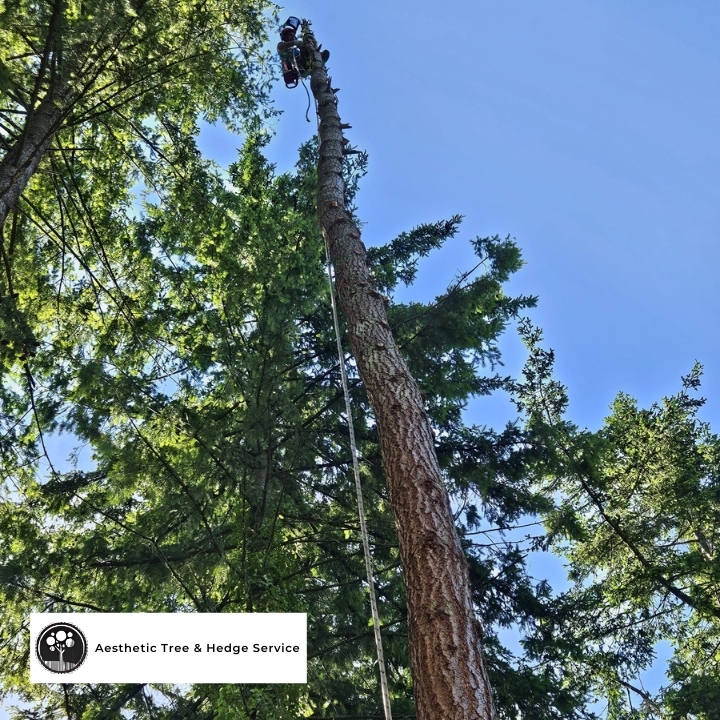
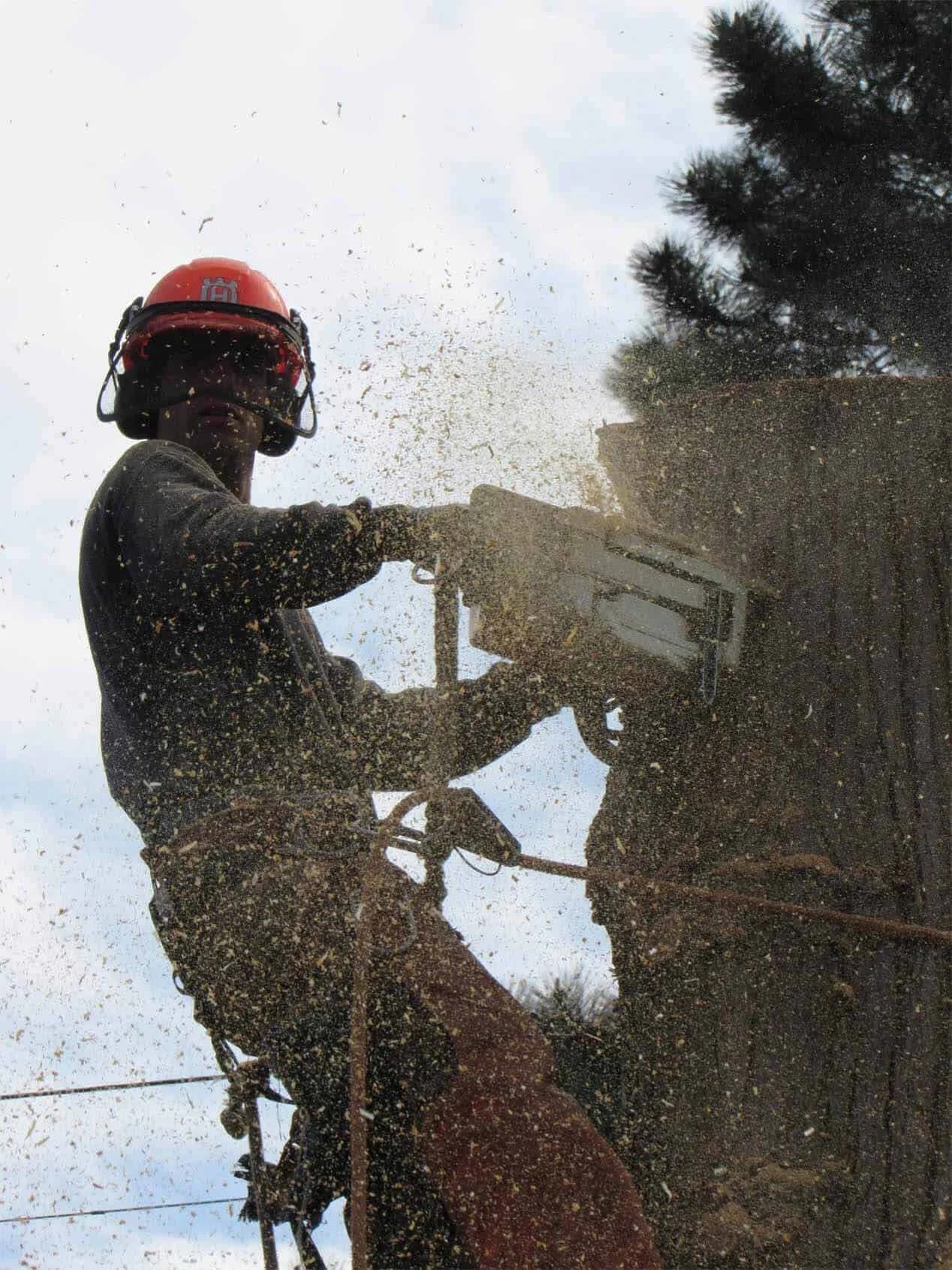
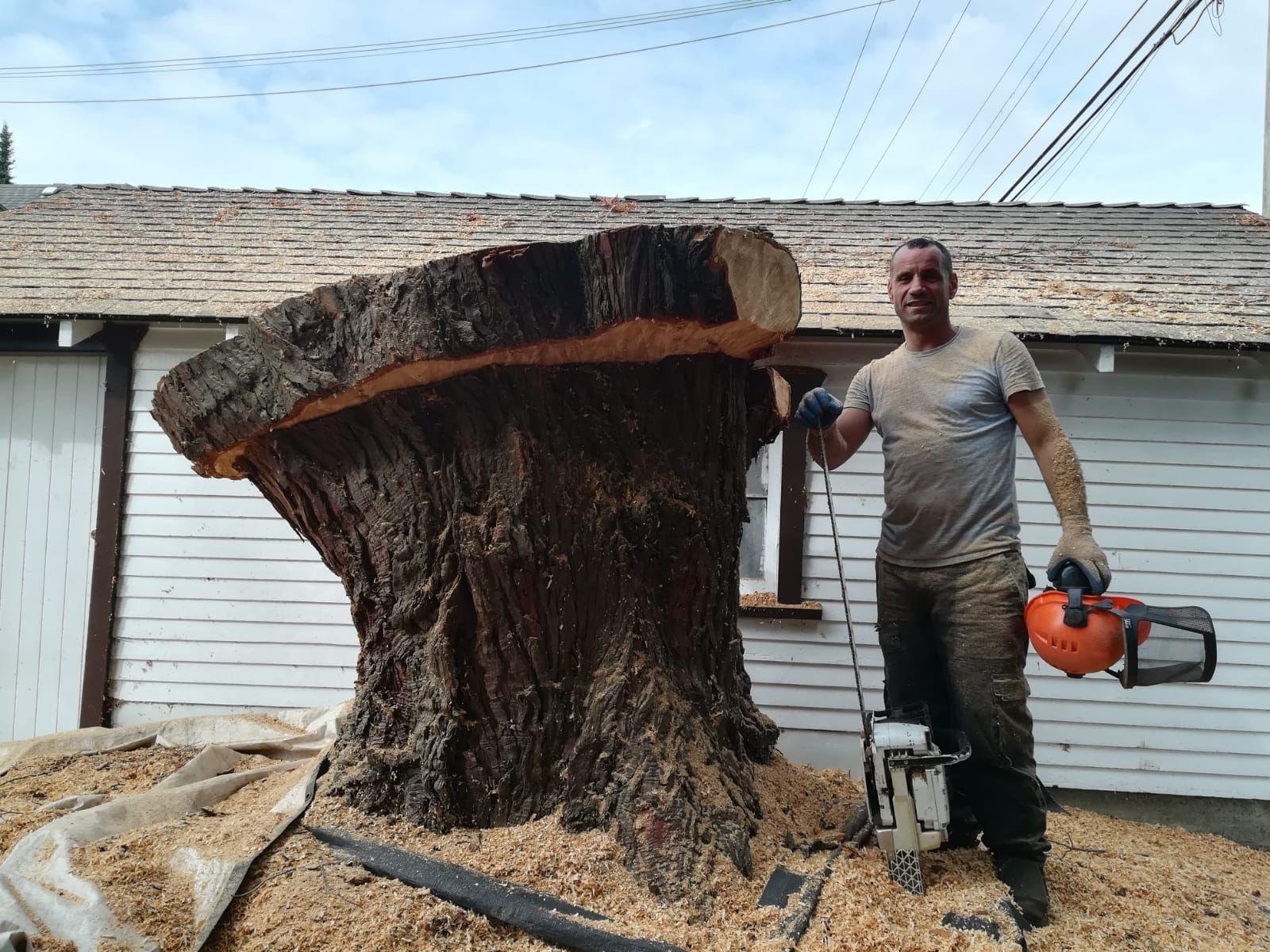
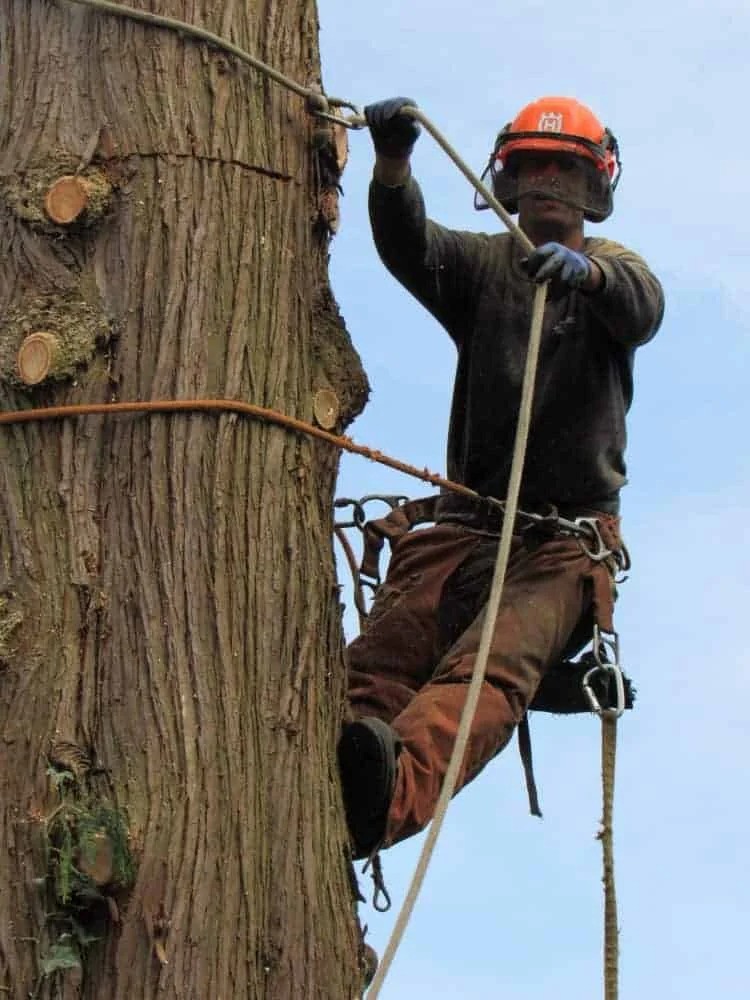
Tree Removal — From small ornamental removals to large cottonwood and cedar takedowns near the Fraser River dyke, we handle every scale of tree removal in Richmond. Our crews use sectional dismantling with rigging when trees are close to structures, power lines, fences, or neighbouring properties. All debris is chipped on site, and the worksite is left clean. We manage the full permit process under Bylaw No. 8057.
Tree Pruning — We provide crown thinning, crown reduction, deadwood removal, structural pruning, and clearance pruning for all tree species common to Richmond. Pruning is the most cost-effective way to extend a tree's lifespan, reduce storm damage risk, and manage canopy size. All pruning follows ISA best practice standards and the ANSI A300 pruning standard. We never top trees.
Stump Grinding — After tree removal, we grind stumps and major surface roots to 15 to 30 cm below grade using tracked stump grinders that work well on Richmond's flat terrain and soft soils. The resulting mulch is typically left in the hole to decompose or can be removed and backfilled with topsoil for replanting or landscaping.
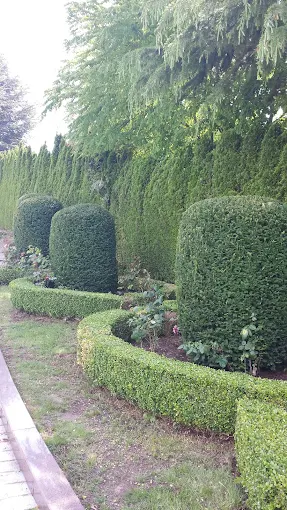
Hedge Trimming — Richmond properties rely heavily on hedges for privacy screening, particularly Western Red Cedar hedges, Laurel (Prunus laurocerasus), Portuguese Laurel, and Photinia. We trim hedges to maintain clean sight lines, promote dense growth, and keep hedges within the height limits expected by municipal guidelines and neighbour relations. We serve both residential and commercial properties.
Arborist Reports — Our ISA-certified arborists prepare detailed arborist reports for tree removal permit applications, development permit applications, TRAQ risk assessments, real estate transactions, insurance claims, and neighbour disputes. Our reports are accepted by the City of Richmond, real estate professionals, lawyers, and insurance adjusters.
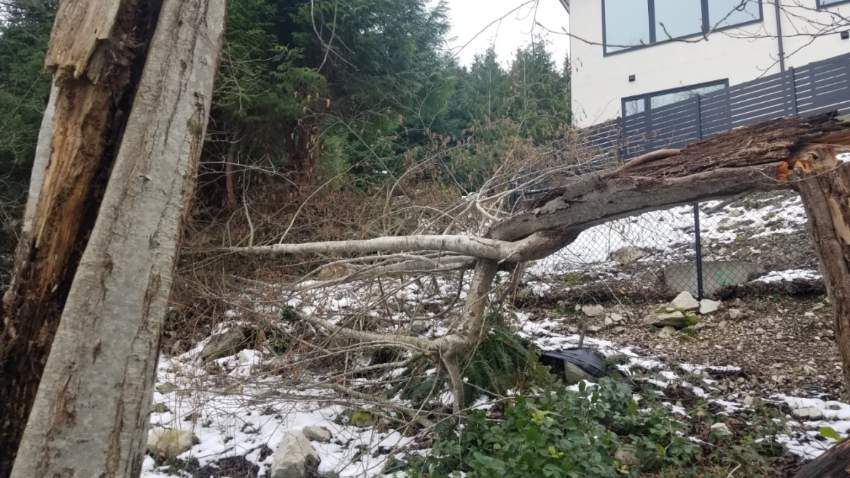
Emergency Tree Service — We provide 24/7 emergency response for storm-damaged, fallen, or hazardous trees across Richmond. Richmond's exposure to Pacific storms and its high water table make windthrow events a regular occurrence during fall and winter storm season. Call (604) 721-7370 for emergency tree service.
Land Clearing — For development projects, lot preparation, and agricultural land conversion, we provide full-scale land clearing services including multi-tree removal, stump grinding, brush clearing, and debris hauling.
Frequently Asked Questions
How much does tree removal cost in Richmond?
Tree removal costs in Richmond vary based on tree size, species, location on the property, proximity to structures and power lines, and access conditions. Typical ranges for 2025-2026 are:
- Small trees (under 6 metres / 20 feet): $300 to $600
- Medium trees (6 to 12 metres / 20 to 40 feet): $600 to $1,500
- Large trees (12 to 18 metres / 40 to 60 feet): $1,500 to $3,500
- Very large or complex removals (over 18 metres, Black Cottonwoods near the Fraser, large cedars adjacent to structures): $3,500 to $8,000+
These ranges include sectional dismantling or felling, chipping of branches, and full cleanup. They do not include stump grinding (typically $150 to $500 per stump) or the municipal permit application fee. We provide free on-site estimates for all Richmond properties.
Do I need a permit to remove a tree on my property in Richmond?
Yes, if the tree has a trunk diameter of 20 cm or more measured at 1.4 metres above the base (diameter at breast height). This applies to all tree species on private property under Richmond's Tree Protection Bylaw No. 8057. An arborist report from an ISA-certified arborist is required as part of the permit application. Removing a protected tree without a permit can result in substantial fines and mandatory replacement planting at a higher ratio. Aesthetic Tree handles the full permit process on your behalf.
What trees are protected under Richmond's tree bylaw?
All trees on private property with a trunk diameter of 20 cm or more at 1.4 metres above the base are protected under Bylaw No. 8057, regardless of species. There is no exemption for specific tree types — whether it is a native Western Red Cedar, a Black Cottonwood, or an ornamental cherry tree, the same diameter threshold applies. Trees within Environmentally Sensitive Areas face additional protections regardless of size.
Can I remove a tree near the Fraser River in Richmond?
Trees near the Fraser River may fall within an Environmentally Sensitive Area (ESA) designation, which adds additional requirements beyond the standard tree removal permit. A Qualified Environmental Professional (QEP) assessment may be required in addition to the standard arborist report. There may also be seasonal work restrictions to avoid disturbing nesting birds and other wildlife. Trees growing on or adjacent to the dyke system face further scrutiny because root removal can affect dyke structural integrity. Our arborists can assess your specific situation and advise on the full scope of approvals needed before any work near the Fraser River.
Does Richmond require replacement trees after removal?
Yes. The City of Richmond requires property owners to plant replacement trees after a permitted tree removal. The number, species, and minimum caliper of replacement trees are determined by the City as part of the permit conditions. The goal is to maintain or increase Richmond's overall urban tree canopy coverage. Replacement trees must be planted within a specified timeline and maintained for a set period. Failure to plant or maintain replacement trees can result in enforcement action. Aesthetic Tree can advise on appropriate replacement species for Richmond's soil and moisture conditions and coordinate the planting on your behalf.
Does Aesthetic Tree serve Steveston and South Richmond?
Yes. We serve all of Steveston, including the historic village area, Steveston North, and the surrounding residential neighbourhoods along the south arm of the Fraser River. We also serve all south Richmond neighbourhoods including Thompson, Seafair, Hamilton, and the semi-rural areas of East Richmond. Our crews are familiar with the specific conditions in south Richmond, including the proximity to the Fraser River, dyke-adjacent properties, and the mix of heritage and newer residential lots. Call (604) 721-7370 to book a free estimate anywhere in Richmond.
What We Do
Services Available in Richmond
Why Choose Us
Why Richmond Trusts Us
Over 20 years of certified expertise, transparent pricing, and a 5.0-star Google rating make us Richmond’s preferred tree care provider.
WCB Registered
Fully insured and WCB-compliant. Your property is protected on every job.
ISA Certified
Our arborists hold ISA credentials — the gold standard in professional tree care.
Best Prices
Transparent, competitive pricing with free on-site estimates. No hidden fees.
Service Areas
Serving Greater Vancouver & the Lower Mainland
Beyond Richmond, our ISA-certified arborists provide professional tree care across the entire Lower Mainland. No job is too big or too small.
View all service areasNeed Tree Service
in Richmond?
Book your free consultation with our ISA-certified arborists today. No obligation, no pressure — just honest advice from professionals who genuinely love tree care.