
ISA-Certified Arborists · Greater Vancouver
Tree Service
Port Coquitlam
ISA-Certified Arborists · Tri-Cities
Aesthetic Tree & Hedge Services provides professional tree removal, pruning, stump grinding, hedge trimming, and arborist reports across the City of Port Coquitlam. From the hillside homes of Citadel Heights and Oxford Heights to the established riverside neighbourhoods of Mary Hill and Lions Park, our ISA-certified arborists bring 20+ years of Tri-Cities experience to every job. Port Coquitlam's mix of mature urban trees, greenway corridors, and growing development activity means property owners regularly need professional arborist services. With 100+ five-star Google reviews and deep knowledge of PoCo's tree bylaw and local terrain, Aesthetic Tree is a trusted choice for tree care in Port Coquitlam. Call (604) 721-7370 for a free, no-obligation estimate.
What Tree Species Are Most Common in Port Coquitlam?
Port Coquitlam sits at the confluence of the Pitt and Coquitlam Rivers, with terrain that ranges from flat floodplain in the south and east to moderate hillside slopes in Citadel Heights and Oxford Heights in the north. This topographic variety, combined with decades of residential landscaping, has created a diverse urban forest:
- Douglas Fir (Pseudotsuga menziesii) — The signature native conifer of the Tri-Cities, Douglas Firs are found throughout Port Coquitlam's older neighbourhoods and on hillside properties in Citadel Heights and Oxford Heights. Mature specimens regularly reach 25 to 40 metres, with some remnant trees exceeding that in areas that were forested within living memory.
- Western Red Cedar (Thuja plicata) — Common as both landscape trees and hedging material across PoCo. Large cedars are particularly prevalent on older lots in Lions Park, Shaughnessy, and Mary Hill, where they were either retained during original development or planted 40+ years ago.
- Bigleaf Maple (Acer macrophyllum) — One of the most common deciduous trees in Port Coquitlam, Bigleaf Maples are found along streets, in parks, and on residential lots throughout the city. Their massive canopies produce heavy leaf litter in autumn and their root systems are known for lifting sidewalks and driveways.
- Paper Birch (Betula papyrifera) — Widely planted in PoCo subdivisions during the 1970s and 1980s, many Paper Birches are now 40 to 50 years old and reaching the end of their natural lifespan. Declining birches with thinning canopies, bark splitting, and bronze birch borer damage are a common removal request.
- Red Alder (Alnus rubra) — Found along the Coquitlam River, Pitt River, and PoCo Trail corridors, alders are fast-growing pioneer trees with a lifespan of 40 to 60 years. They frequently lean over trails, roads, and property edges as they age.
- Ornamental species — Port Coquitlam's residential areas include a wide variety of planted ornamental trees: flowering cherries, crabapples, ornamental plums, Japanese maples, and columnar hornbeams. These species require specialized pruning to maintain their form and health.
Each species has specific pruning requirements, failure modes, and lifespan characteristics that our arborists account for in every assessment.
How Does the City of Port Coquitlam Tree Bylaw Work?
The City of Port Coquitlam regulates tree removal through its Tree Protection Bylaw, which requires a permit before removing any tree that meets or exceeds the specified trunk diameter threshold measured at 1.4 metres above the base (diameter at breast height, or DBH) on private property within city limits.
What the permit application requires:
- A completed Tree Removal Permit application signed by the registered property owner
- A site plan showing the tree's location relative to buildings, property lines, and neighbouring structures
- An arborist report from an ISA-certified or registered consulting arborist documenting the tree's species, size, health, structural condition, and the rationale for removal
- A replacement tree plan or cash-in-lieu payment as specified by the City
Processing time is typically 2 to 4 weeks. Permits are valid for a set period once approved.
Replacement requirements: The City requires replacement tree planting for each permitted removal. The number and caliper of replacement trees depends on the size of the removed tree. When on-site planting is not possible due to lot size or other constraints, cash-in-lieu payments are accepted and directed toward the City's urban forestry program.
Streamside and environmental protections: Port Coquitlam has several important waterways, including the Coquitlam River, Pitt River, and Hyde Creek. Trees within Streamside Protection and Enhancement Areas (SPEAs) and Environmentally Sensitive Areas (ESAs) are subject to additional protections. Removal of trees in these zones may require environmental assessments and additional municipal approvals beyond the standard tree permit.
Penalties: Unauthorized removal of protected trees can result in fines and mandatory replacement planting at increased ratios.
Aesthetic Tree manages the full permit process for Port Coquitlam property owners, from the arborist assessment through to the application submission and replacement tree planning.
What Makes Port Coquitlam's Urban Forest Unique Compared to Neighbouring Cities?
Port Coquitlam has a character distinct from its larger neighbours, Coquitlam and Port Moody. Understanding what makes PoCo's tree care landscape different helps property owners make informed decisions about their trees.
Flatter terrain with hillside exceptions. Unlike Coquitlam's Burke Mountain or the steep slopes of the North Shore, most of Port Coquitlam sits on relatively flat to gently rolling terrain. This means standard equipment access is usually straightforward, and bucket trucks and cranes can reach most trees without the specialized rigging required on steep hillside properties. The exceptions are Citadel Heights and Oxford Heights, where moderate slopes and tiered lot configurations can create access challenges similar to those found in hillier communities.
Established mature tree canopy. Port Coquitlam's core residential areas — Lions Park, Mary Hill, Shaughnessy, Lincoln Park, and Glenwood — were largely developed between the 1950s and 1980s. The trees planted during those decades are now 40 to 70 years old, and many are reaching the size and age where significant maintenance, risk assessment, and removal become necessary. This is a fundamentally different tree care environment than a new Burke Mountain subdivision where the primary concern is recently exposed forest trees.
The PoCo Trail and greenway corridors. Port Coquitlam is threaded with an extensive trail and greenway network, anchored by the PoCo Trail that loops through much of the city. These corridors contain significant urban forest, with mature conifers, deciduous trees, and riparian vegetation lining the trails. Trees adjacent to trails create both amenity and liability: a leaning alder or dead birch near a busy trail section is a public safety concern that property owners or the City must address.
Floodplain considerations. The southern and eastern portions of Port Coquitlam sit on historic Pitt River floodplain. Trees in these areas may have shallow root systems due to high water tables, making them more susceptible to windthrow than the same species growing on higher, better-drained ground. Soil conditions affect root stability, and our arborists account for this when assessing tree risk and recommending management options.
Growing infill development. Like many Metro Vancouver municipalities, Port Coquitlam is experiencing increased infill development as older single-family lots are redeveloped with duplexes, townhomes, and larger single-family homes. This development often requires the removal of mature trees that have been on the property for decades, triggering permit requirements and replacement obligations. Our arborists prepare Tree Management Plans for these development projects to City standards.
What Does Tree Removal Cost in Port Coquitlam?
Tree removal costs in Port Coquitlam are generally moderate compared to steeper, more access-challenged municipalities. The flatter terrain and better road access in most PoCo neighbourhoods help keep costs competitive. Here are typical cost ranges for 2025-2026:
- Small trees (under 6 metres / 20 feet): $200 to $450
- Medium trees (6 to 12 metres / 20 to 40 feet): $450 to $1,200
- Large trees (12 to 18 metres / 40 to 60 feet): $1,200 to $3,000
- Very large or complex removals (over 18 metres / 60+ feet, near structures or power lines): $3,000 to $8,000+
These ranges include felling or sectional dismantling, chipping of branches, and full site cleanup. They do not include stump grinding (typically $100 to $400 per stump) or the municipal permit application fee.
Factors that increase cost in Port Coquitlam:
- Trees in tight rear yards with limited access, requiring hand-carry of all debris
- Proximity to structures, fences, or neighbouring properties requiring precision rigging
- Trees within BC Hydro utility line clearance zones
- Hillside properties in Citadel Heights or Oxford Heights with steeper grades
- Trees with significant decay, insect damage, or structural defects that make climbing unsafe
- Emergency or after-hours storm damage response (30% to 50% surcharge)
- Multi-tree projects on development sites
We provide free on-site estimates for all Port Coquitlam properties.
What Tree Pruning and Maintenance Services Do We Offer in Port Coquitlam?
Professional pruning is the most cost-effective way to maintain healthy, safe, and attractive trees. Our ISA-certified arborists provide the following pruning services across Port Coquitlam:
- Crown thinning — Selectively removing interior branches to reduce wind resistance, improve light penetration, and lighten the canopy load. Important for large Bigleaf Maples and Douglas Firs that have developed dense, heavy canopies.
- Crown reduction — Shortening the overall height or spread by cutting back to appropriate lateral branches. Used when trees have outgrown their space or require clearance from structures, power lines, or neighbouring properties.
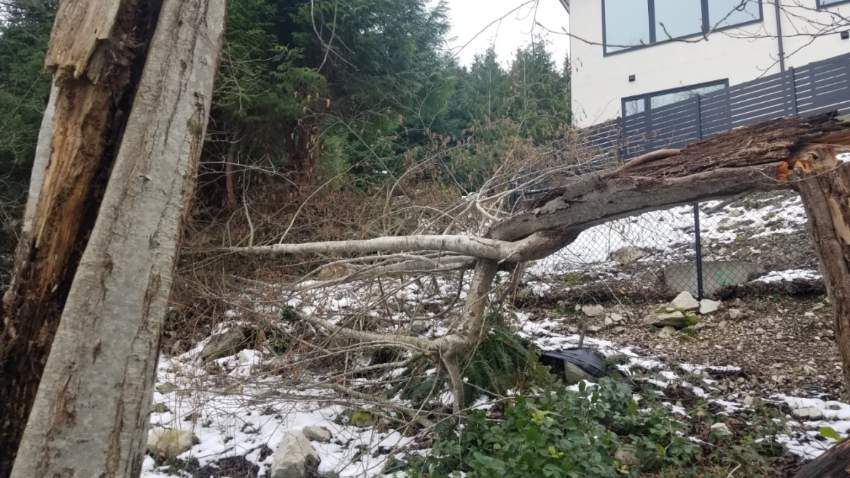
- Deadwood removal — Removing dead, dying, and broken branches before they fall. This is a critical safety service for trees near trails, sidewalks, driveways, and play areas, and it is one of our most-requested maintenance services in PoCo.
- Crown raising — Removing lower branches to provide clearance for pedestrians, vehicles, mowing equipment, and sightlines. Common for street trees and trees along the PoCo Trail.
- Formative pruning for young trees — Training young trees with proper branch structure to prevent future defects and reduce long-term maintenance costs. Especially valuable for the ornamental and replacement trees planted throughout PoCo.
- Fruit tree pruning — Port Coquitlam has a large number of backyard fruit trees, including apple, pear, cherry, and plum. Annual dormant-season pruning improves fruit production, reduces pest and disease pressure, and maintains manageable tree size.
All pruning follows ISA best practice standards and the ANSI A300 pruning standard. We never top trees. Topping creates long-term structural hazards and is harmful to tree health.
How Does Stump Grinding Work in Port Coquitlam?
Stump grinding removes the visible stump and major surface roots to 15 to 30 cm below grade using a specialized machine with a rotating carbide-tipped cutting wheel. This allows the area to be replanted, sodded, or landscaped.
Typical stump grinding costs in Port Coquitlam:
- Small stumps (under 30 cm diameter): $100 to $200
- Medium stumps (30 to 60 cm diameter): $200 to $350
- Large stumps (over 60 cm diameter): $350 to $600+
Port Coquitlam's generally flat terrain makes stump grinding straightforward in most neighbourhoods. Standard self-propelled stump grinders can access most properties through side gates or along driveways. For stumps in tight backyard spaces, we use compact tracked grinders.
For development sites requiring multiple stump removals, we offer package pricing. The mulch generated by grinding is typically left in the hole to decompose naturally, or we remove it and backfill with topsoil on request.
What Hedge Trimming Services Are Available in Port Coquitlam?
Hedges are a common landscape feature across Port Coquitlam, providing privacy, wind screening, and property definition. The most common hedge species we maintain in PoCo include:
- Western Red Cedar (Thuja plicata) — The dominant hedge species in Port Coquitlam, cedar hedges grow vigorously and need annual or semi-annual trimming to maintain density, shape, and a tidy appearance.
- Laurel (Prunus laurocerasus) — Common in established neighbourhoods, English Laurel grows aggressively and can quickly overwhelm adjacent plantings and pathways if not maintained.
- Emerald Cedar (Thuja occidentalis 'Smaragd') — Popular in newer subdivisions for its naturally compact, columnar form. Requires less frequent trimming than Western Red Cedar.
- Privet (Ligustrum) — Found on older properties, privet hedges are fast-growing deciduous or semi-evergreen hedges that require frequent trimming during the growing season.
- Boxwood (Buxus) — Used for formal low hedges and border plantings, common in front yards and along walkways.
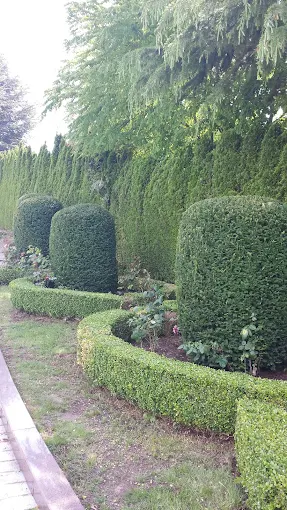
Our hedge trimming service includes shaping, height reduction, side trimming, and cleanup. We serve residential, strata, and commercial properties across all PoCo neighbourhoods, with both one-time and recurring maintenance options.
When Should You Request an Arborist Report in Port Coquitlam?
Arborist reports are professionally prepared assessments of tree species, size, health, structural condition, and risk level. They are required or recommended in several common situations for Port Coquitlam property owners:
- Tree removal permit applications — The City of Port Coquitlam requires an arborist report for any protected tree removal application. The report must document the tree's condition and provide a rationale for removal.
- Development and building permits — New construction, renovations, additions, and any project involving ground disturbance near trees requires a Tree Management Plan prepared by a certified arborist. With PoCo's increasing infill development, this is one of our most common report types.
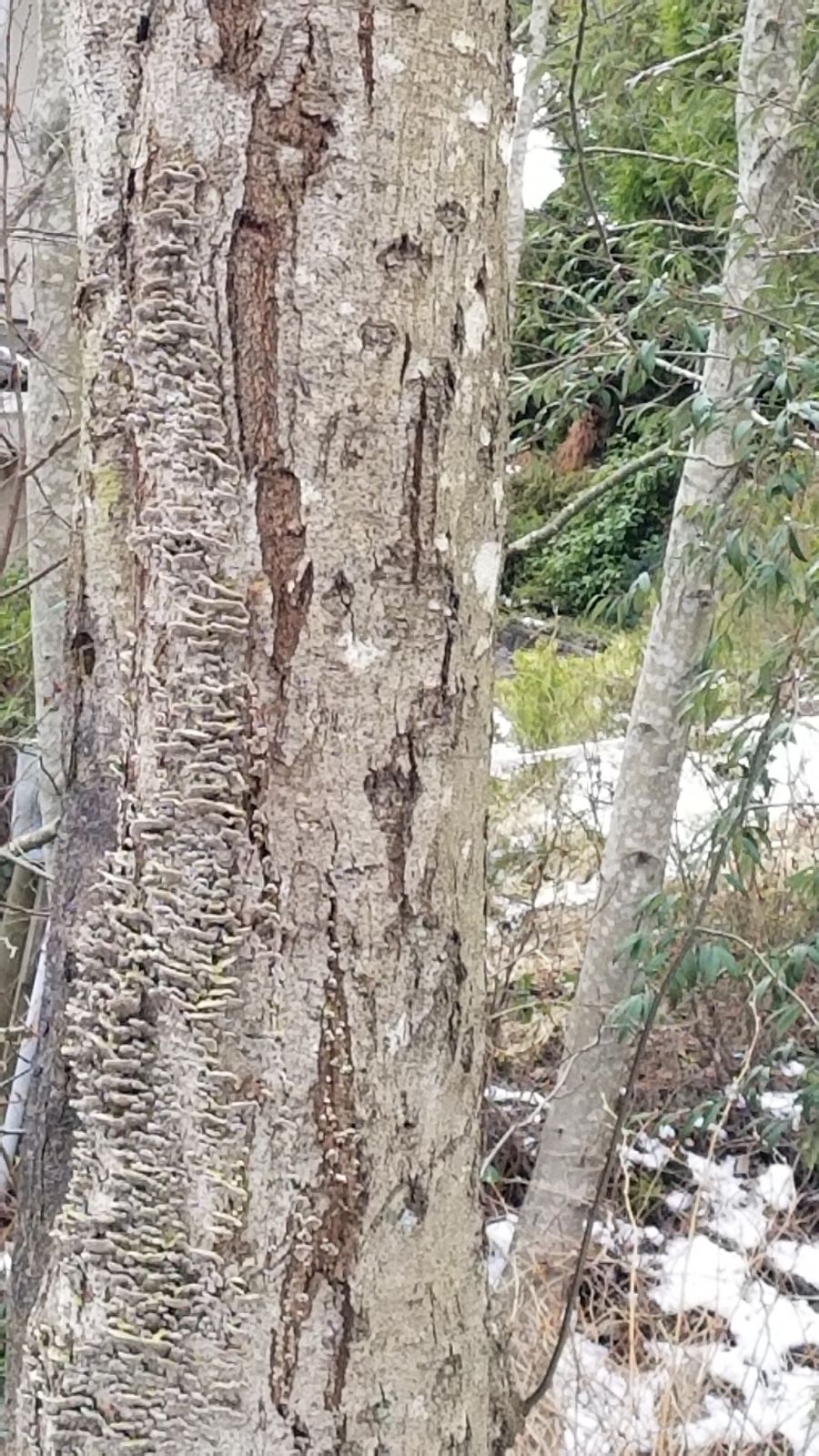
- TRAQ risk assessments — When a tree shows signs of structural failure (leaning, cracking, fungal fruiting bodies, root heaving, or storm damage), a Tree Risk Assessment Qualification (TRAQ) assessment provides a standardized, defensible risk evaluation accepted by municipalities and insurance companies.
- Pre-purchase assessments — Home buyers benefit from understanding the condition and potential costs of significant trees on a property before closing the sale. Large, aging trees can represent thousands of dollars in future maintenance or removal costs.
- Neighbour disputes — Trees that overhang property lines, drop debris, block light, or have invasive root systems are common sources of neighbour conflict. An independent arborist report provides an objective, professional assessment that can help resolve disputes.
- Insurance claims — After storm damage or tree failure, an arborist report documents the tree's condition, the nature of the failure, and the extent of damage for insurance purposes.
- Streamside and environmental compliance — Properties near the Coquitlam River, Pitt River, Hyde Creek, or other waterways may require arborist reports demonstrating that proposed tree work will not adversely affect streamside protection areas.
Our arborist reports comply with City of Port Coquitlam requirements and are accepted by municipal planning departments, developers, real estate professionals, lawyers, and insurance adjusters.
Which Port Coquitlam Neighbourhoods Does Aesthetic Tree Serve?
We serve every neighbourhood across the City of Port Coquitlam, including:
- Citadel Heights — PoCo's most elevated residential area, with moderate hillside terrain, larger lots, and a mix of native conifers and established landscaping. Some properties here have access challenges similar to hillier communities.
- Oxford Heights — Established hillside neighbourhood adjacent to Citadel Heights, with mature trees and moderate slopes.
- Lions Park — One of PoCo's oldest and most established residential areas, with mature Bigleaf Maples, cedars, birches, and a wide variety of ornamental trees. Many trees here are 50+ years old and reaching the age where professional assessment is important.
- Mary Hill — Residential neighbourhood along the Pitt River, with mature trees and proximity to the waterfront trail system.
- Riverwood — Newer residential area near the Pitt River, with a mix of retained native trees and planted ornamental species.
- Lincoln Park — Established neighbourhood centred on Lincoln Park, with mature street trees and backyard specimens.
- Shaughnessy — Residential area with a mix of older and newer housing stock, mature trees, and good access for equipment.
- Fremont Village — Newer residential community in PoCo's west end, with planted street trees and young landscape trees.
- Glenwood — Established residential area with mature trees and proximity to greenway corridors.
No matter which Port Coquitlam neighbourhood you are in, we provide free on-site estimates within 48 hours.
The PoCo Trail Corridor and Urban Forest Management
Port Coquitlam's extensive trail and greenway network is one of the city's defining features, and it creates a unique urban forestry context. The PoCo Trail, which loops for approximately 25 kilometres through the city, passes through and adjacent to residential, commercial, and natural areas. Trees along these corridors provide shade, habitat, and scenic value, but they also require ongoing management.
Common trail corridor tree issues:
- Leaning or structurally compromised trees near trail paths — Alders, birches, and cottonwoods along trail edges frequently develop structural problems as they age. A single failure can block a trail and pose serious safety risks to trail users.
- Overhanging branches reducing clearance — Trail maintenance requires minimum overhead clearance for pedestrians, cyclists, and maintenance vehicles. Crown raising and deadwood removal keep corridors safe and usable.
- Root heaving of trail surfaces — Large tree roots can lift and crack asphalt or gravel trail surfaces, creating tripping hazards. Root management, including selective root pruning and surface repair, is sometimes needed.
- Invasive species management — English Ivy, Himalayan Blackberry, and other invasive species often climb and smother trees along trail corridors, weakening them over time.
If you have trees on your property that border the PoCo Trail or any greenway corridor, we can assess their condition and recommend appropriate maintenance to address both your property needs and any trail safety concerns.
Frequently Asked Questions About Tree Services in Port Coquitlam
Do I need a permit to remove a tree on my Port Coquitlam property?
The City of Port Coquitlam requires a Tree Removal Permit for any tree that meets or exceeds the protected diameter threshold. The application requires an arborist report, site plan, and replacement tree plan. Removing a protected tree without a permit can result in fines and replacement planting requirements. Aesthetic Tree manages the full permit process for you.
Is tree removal cheaper in Port Coquitlam than in North or West Vancouver?
Generally, yes. Port Coquitlam's flatter terrain and better equipment access in most neighbourhoods result in lower costs compared to the steep hillside work common on the North Shore. However, costs still vary significantly based on tree size, species, proximity to structures, and access conditions on individual properties.
My Paper Birch trees look unhealthy. Should I have them assessed?
Yes. Many Paper Birches planted in PoCo during the 1970s and 1980s are now reaching the end of their natural 50 to 70-year lifespan. Signs of decline include thinning canopy, bark splitting, dead branches in the upper crown, and bronze birch borer damage (D-shaped exit holes in the bark). Our arborists can assess whether your birches can be maintained through pruning or whether removal is the safer and more cost-effective option.
Do you provide arborist reports for infill development in Port Coquitlam?
Yes. We regularly prepare Tree Management Plans for infill development projects in PoCo, including lot splits, duplexes, townhome developments, and single-family rebuilds. These reports include a full tree inventory, impact assessment, tree protection specifications for retained trees, and a removal and replacement plan. Our reports meet City of Port Coquitlam requirements for building permit applications.
Can you prune fruit trees in Port Coquitlam?
Yes. We prune apple, pear, cherry, plum, and other fruit trees. The best time for structural and maintenance pruning of most fruit trees is during the dormant season, typically December through February. Dormant pruning reduces disease transmission risk and allows you to see the branch structure clearly. We also provide summer pruning for size management and to remove water sprouts.
Do you offer emergency tree service in Port Coquitlam?
Yes. We provide 24/7 emergency response for storm-damaged, fallen, or hazardous trees across Port Coquitlam. Emergency service is available outside regular business hours and carries a surcharge of 30% to 50% depending on conditions. Call (604) 721-7370 for emergency tree service in the Tri-Cities.
What We Do
Services Available in Port Coquitlam
Why Choose Us
Why Port Coquitlam Trusts Us
Over 20 years of certified expertise, transparent pricing, and a 5.0-star Google rating make us Port Coquitlam’s preferred tree care provider.
WCB Registered
Fully insured and WCB-compliant. Your property is protected on every job.
ISA Certified
Our arborists hold ISA credentials — the gold standard in professional tree care.
Best Prices
Transparent, competitive pricing with free on-site estimates. No hidden fees.
Service Areas
Serving Greater Vancouver & the Lower Mainland
Beyond Port Coquitlam, our ISA-certified arborists provide professional tree care across the entire Lower Mainland. No job is too big or too small.
View all service areasNeed Tree Service
in Port Coquitlam?
Book your free consultation with our ISA-certified arborists today. No obligation, no pressure — just honest advice from professionals who genuinely love tree care.