Hedge Trimming & Pruning Vancouver — Cedar, Laurel & Privacy Screens
Expert hedge trimming for residential and strata properties across Greater Vancouver. Cedar, laurel, boxwood, and yew specialists with ISA-certified crews.
Years Experience
Trees Serviced
Liability Insurance
Google Rating
At a Glance
What You Need to Know
Aesthetic Tree provides professional hedge trimming across Greater Vancouver — from 4-foot cedar borders to 30-foot privacy screens. We work with all major species: Western red cedar, English laurel, Portuguese laurel, boxwood, and yew. Our crews follow ANSI A300 pruning standards to promote dense, healthy growth without shocking the plant. Strata properties benefit from our recurring maintenance contracts with guaranteed scheduling.
Investment
$300 – $1,500+
Availability
Scheduling within 1-2 weeks
01
What Does Professional Hedge Trimming in Vancouver Include?
Professional hedge trimming is more than running a power trimmer along the top. Our crews assess the species, growth pattern, and health of your hedge before making a single cut. Western red cedar (Thuja plicata) requires a completely different approach than English laurel (Prunus laurocerasus) — cutting cedar back to bare wood kills the branch, while laurel responds vigorously to hard pruning.
Every hedge trimming service includes: shaping and leveling the top, trimming the sides for a clean vertical or tapered profile, clearing the base of debris and suckers, and complete site cleanup. We haul away all clippings — your property is left cleaner than we found it.
For tall hedges (over 10 feet), we use professional-grade extended-reach trimmers and ladder systems to achieve a clean, level finish that hand-held trimmers cannot match. Our crews are trained in fall protection and follow WorkSafeBC height-of-work regulations.
When Should You Trim Hedges in Vancouver?
In Vancouver's temperate oceanic climate, most hedges benefit from 2 to 3 trims per year. The optimal schedule depends on species: cedar hedges are best trimmed in late spring (May-June) and again in early fall (September). Laurel hedges grow more aggressively and often need three cuts — spring, mid-summer, and early fall.
Timing matters for plant health. Trimming too late in fall (after October) can stimulate tender new growth that is vulnerable to winter frost. Trimming too early in spring (before April) risks removing overwintering beneficial insects. Our arborists schedule your trims at the biologically optimal window for your specific hedge species.
The City of Vancouver has sightline bylaws requiring hedges at intersections and driveways to be maintained below certain heights for pedestrian and vehicle safety. We ensure your hedge meets municipal requirements while preserving maximum privacy.

03
Hedge Trimming for Strata Properties and Commercial Sites
Strata councils and property managers across Greater Vancouver rely on Aesthetic Tree for scheduled hedge maintenance. We service entire complexes in a single visit — coordinating access, managing resident notifications, and delivering consistent results across every building in the strata.
Our strata maintenance contracts include: guaranteed scheduling windows, consistent crew assignment so the same people know your property, detailed post-service reports for council meetings, and priority emergency response for storm damage between scheduled visits.
We carry $5M in liability insurance and are fully WorkSafeBC compliant — the documentation strata councils and property management firms need for vendor approval. References from current strata clients are available on request.
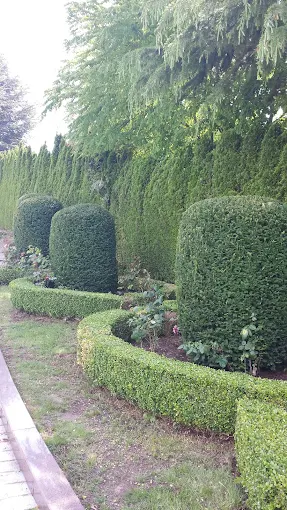
Aesthetic Tree & Hedge Services has trimmed, shaped, and maintained hedges across Vancouver for over 20 years. We specialize in oversized and extra-large hedges — the 3-metre-tall cedar screens, the towering laurel walls, and the formal boxwood borders that define Vancouver's residential landscapes. Our work is recognized for precision straight-line cuts, clean shaping, and attention to each species' growth habit. Whether you need a single annual trim or an ongoing maintenance plan, we deliver results that keep your hedges healthy, dense, and beautifully shaped. Call (604) 721-7370 for a free estimate.
Why Do Hedges Need Regular Trimming?
Hedges are living structures that grow continuously. Without regular trimming, they become overgrown, bare at the base, thin in the middle, and increasingly difficult (and expensive) to restore. Regular trimming provides four key benefits:
Density and privacy. Trimming stimulates branching along the cut edges, which fills in the hedge and creates the thick, opaque screen that provides privacy from neighbours and noise reduction from streets. An untrimmed hedge becomes open and leggy at the base, defeating its purpose as a screen.
Plant health. Proper trimming removes dead, diseased, or insect-damaged growth before problems spread. It also allows light and air to penetrate the interior of the hedge, reducing the damp conditions that promote fungal diseases like blight and powdery mildew.
Controlled size. Left untrimmed, most hedge species in Vancouver grow 30 to 90 cm per year. A cedar hedge that is manageable at 2 metres can reach 4 metres in two seasons, shading out gardens, encroaching on neighbours, and becoming a major restoration project.
Property value and curb appeal. Well-maintained hedges frame a property and signal good stewardship. Overgrown, uneven hedges do the opposite. In Vancouver's competitive real estate market, landscape presentation matters.
Which Hedge Species Are Most Common in Vancouver?
Vancouver's mild, maritime climate supports a wide range of hedge species. Each has different growth rates, trimming requirements, and ideal maintenance schedules:
Western Red Cedar (Thuja plicata)
The most popular hedge species in the Greater Vancouver area. Western Red Cedar grows at a moderate rate (30 to 60 cm per year), tolerates heavy shade, and responds well to trimming. It can be maintained at any height from 1.5 to 6+ metres. Best trimmed once per year in late spring to early summer, after the new growth flush has partially hardened. Avoid cutting into old, brown interior wood — cedar does not regenerate from bare wood.
English Laurel (Prunus laurocerasus)
A fast-growing broadleaf evergreen (60 to 90 cm per year) that creates a dense, glossy screen. Laurel tolerates heavy pruning and can regenerate from hard cuts, making it forgiving for renovation work. It should be trimmed with hand pruners or loppers rather than hedge shears to avoid cutting leaves in half, which causes browning. Best trimmed twice per year: once in late spring and once in late summer.
Boxwood (Buxus sempervirens)
The classic formal hedge plant. Boxwood grows slowly (10 to 15 cm per year) and holds its shape well between trimmings. It is ideal for low borders, parterres, and formal garden edging. Trim once or twice per year in late spring to midsummer. Boxwood is susceptible to boxwood blight (Calonectria pseudonaviculata), which has been found in British Columbia — inspect regularly for dark leaf spots and stem streaking.
Privet (Ligustrum)
A fast-growing deciduous or semi-evergreen hedge that needs frequent trimming — typically 3 to 4 times per year to maintain a formal shape. Privet is aggressive and can become invasive if left unmanaged. It is one of the few hedge species that tolerates severe renovation pruning, making it a good candidate for restoration.
Portuguese Laurel (Prunus lusitanica)
Similar to English Laurel but slower growing and more refined in appearance, with dark green leaves on red stems. It tolerates harder pruning than many broadleaf evergreens and maintains density well. Trim once or twice per year.
How Much Does Hedge Trimming Cost in Vancouver?
Hedge trimming pricing depends on the hedge's length, height, thickness, species, and site access:
- Hourly rate: $65 to $90 per hour (arborist labour)
- Per 10-foot (3-metre) length: $25 to $60, depending on height
- Typical residential job (30 to 50 linear feet, under 2 metres tall): $200 to $500
- Medium to large jobs (50 to 100+ linear feet, 2 to 4 metres tall): $500 to $1,200
- Oversized hedge renovation (height reduction, heavy reshaping): $800 to $2,000+
Factors that affect pricing:
- Height (hedges over 3 metres require ladders or aerial equipment)
- Thickness (overgrown hedges take significantly longer than well-maintained ones)
- Access (hedges along fences, on slopes, or with limited equipment access cost more)
- Species (laurel requires hand-cutting; cedar can be trimmed with powered shears)
- Debris volume and disposal requirements
We provide free on-site estimates and offer annual maintenance plans at discounted rates for repeat clients.
When Is the Best Time to Trim Hedges in Vancouver?
The optimal trimming schedule depends on the species and the type of hedge (formal vs. informal):
Formal hedges (maintained at a specific height and shape): Trim 1 to 3 times per year, depending on species growth rate. The first trim should be timed to after the spring growth flush has partially hardened — typically late May to early June in Vancouver. A second trim in late August to early September catches late-season growth and keeps the hedge neat through winter.
Informal hedges (allowed to grow in a more natural form): Trim once per year, typically after flowering for flowering species (like escallonia or forsythia) or in late winter for non-flowering evergreens.
Important nesting season note: The Migratory Birds Convention Act protects active bird nests across Canada. During the nesting season (March 15 to August 15), inspect your hedge carefully before trimming. If active nests are present, the hedge must be left undisturbed until all young birds have fledged. Our crews conduct visual nest checks before beginning any hedge work during this period.
Renovation timing: If a hedge needs significant height reduction or hard pruning to restore its shape, the best time is late winter (February to March) for most evergreen species. This allows the plant to put its full spring energy into regrowth from the cut points.
Can an Overgrown Hedge Be Restored to a Manageable Size?
Yes, in most cases. The approach depends on the species:
Species that tolerate hard renovation pruning: English Laurel, Portuguese Laurel, privet, yew, and holly can all be cut back severely — even to bare trunks — and will regenerate new growth. This type of renovation is typically done over one to two seasons.
Species that require gradual reduction: Western Red Cedar, Leyland Cypress, and most other conifers cannot regenerate from bare wood. If you cut a cedar hedge back into the brown interior, those sections will remain bare permanently. For these species, height and width must be reduced gradually — no more than one-third of the total in any single year, taken off the top and sides while preserving green foliage on all surfaces. A severely overgrown cedar hedge typically takes 2 to 3 years of staged reduction to bring back to a manageable size.
We assess every overgrown hedge individually and provide a realistic restoration plan, including an honest assessment of whether renovation is feasible or whether replacement is the better investment.
How Do We Achieve Precision Straight Lines on Tall Hedges?
Straight, level lines on a 3 or 4 metre tall hedge are not achieved by eyeballing. Our process uses:
- String lines. We set level string lines at the desired finished height using stakes at each end of the hedge. This gives us a physical reference for the entire length of the cut.
- Graduated trimming. We work from one end to the other in a single pass, maintaining contact with the string line throughout. This prevents the gradual drift that causes uneven height over long runs.
- Side taper. We cut the sides at a slight inward taper (narrower at the top than the bottom) to ensure sunlight reaches the lower portions of the hedge. This prevents the common problem of hedges that are full on top but bare and leggy at the base.
- Stepping back. We regularly step back to view the hedge from a distance, checking for dips, bulges, or inconsistencies that are not visible up close.
This technique is our signature. After 20+ years of specialization, our straight-line work is consistent enough that clients regularly mention it in reviews.
Areas We Serve
We provide hedge trimming services throughout Vancouver, including Arbutus Ridge, Dunbar-Southlands, Kerrisdale, Kitsilano, Point Grey, Shaughnessy, South Granville, Oakridge, Marpole, and all other Vancouver neighbourhoods. We also serve North Vancouver, West Vancouver, Burnaby, Coquitlam, and Port Coquitlam.
Frequently Asked Questions
How much does hedge trimming cost in Vancouver?
Hedge trimming in Vancouver typically costs $65 to $90 per hour for arborist labour. A typical residential job (30 to 50 linear feet, under 2 metres tall) runs $200 to $500. Larger or overgrown hedges can cost $500 to $1,200 or more. Pricing depends on the hedge's height, length, species, and access conditions.
How often should I trim my hedges?
Most hedges in Vancouver need trimming once or twice per year. Fast-growing species like privet may need 3 to 4 trims per year. Slow-growing species like boxwood need only one trim. Cedar and laurel hedges typically perform best with one to two annual trims timed to their growth cycle.
What is the best time of year to trim hedges in Vancouver?
The first trim should follow the spring growth flush — typically late May to early June. A second trim in late August to early September keeps hedges neat through winter. Avoid heavy trimming during the March 15 to August 15 nesting season without first checking for active bird nests, as required by the Migratory Birds Convention Act.
Can I cut my cedar hedge back to bare wood?
No. Western Red Cedar and most other conifers cannot regenerate from bare, brown wood. If you cut into the interior where there is no green foliage, those sections will remain permanently bare. Cedar hedges must be reduced gradually, taking no more than one-third of the total height and width per year while preserving green foliage on all surfaces.
How do I keep the bottom of my hedge from going bare?
The most common cause of bare lower branches is insufficient light. If the hedge is wider at the top than at the bottom, the lower portions are shaded out and eventually drop their foliage. The solution is to maintain a slight inward taper — wider at the base, narrower at the top — so sunlight reaches all levels of the hedge. This shaping should be established early and maintained with every trim.
Should I use hedge shears or hand pruners?
For small-leaved species like cedar, boxwood, and privet, powered hedge shears create clean, efficient cuts. For large-leaved species like English Laurel and Portuguese Laurel, hand pruners or loppers are preferred because shears cut leaves in half, causing unsightly browning on the cut edges. Our crews use the appropriate tool for each species.
Time for a Hedge Trim?
Get a free estimate for your residential or strata hedge trimming. We handle everything from 4-foot cedar borders to 30-foot privacy screens.
How It Works
Our Process —
Start to Finish
From your first call to final cleanup, every step is handled by certified professionals with clear communication throughout.
Start With a Free QuoteFree Consultation
Our ISA-certified arborist visits your property, assesses the situation, and provides a detailed written quote — no phone estimates.
Permit & Planning
We handle all municipal permits, coordinate with BC Hydro if needed, and create a detailed work plan for safe execution.
Professional Execution
Our crew executes the work following ANSI Z133 safety standards. Most residential jobs are completed in a single day.
Complete Cleanup
Debris removal, site cleanup, and final walkthrough. Your property is left cleaner than we found it — guaranteed.
Our Work
See It In Action
Common Questions
FAQ
Everything you need to know about our hedge trimming vancouver services.
Explore More
Related Services
Serving All of Greater Vancouver
Need Hedge Trimming Vancouver in Vancouver?
Get a free, no-obligation estimate from our ISA-certified arborists. We serve all of Greater Vancouver with professional, insured tree care.