
TL;DR — Quick Summary
Benefits of stump grinding protect your yard from disease, pests, and tripping hazards. ISA-certified arborists across Vancouver. Free estimate.
The stump sitting in your yard is not a harmless remnant. It's an active liability.
Benefits of stump grinding go far beyond aesthetics. A leftover stump decays slowly — over 7 to 10 years in Metro Vancouver's wet climate. During that entire time, it harbours disease organisms, attracts destructive insects, and creates real safety risks for anyone walking near it. This guide covers every reason to grind that stump — and exactly what happens to your property if you don't.
TL;DR
- A leftover stump is a disease factory. Armillaria root rot spreads from decaying stumps to live, healthy trees within your yard through direct root contact and underground rhizomorphs.
- Rotting stumps attract carpenter ants and Pacific dampwood termites. Once colonies establish in the stump, satellite colonies move into your home's structure.
- Stump grinding reclaims usable yard space, removes tripping hazards, and improves property presentation and value.
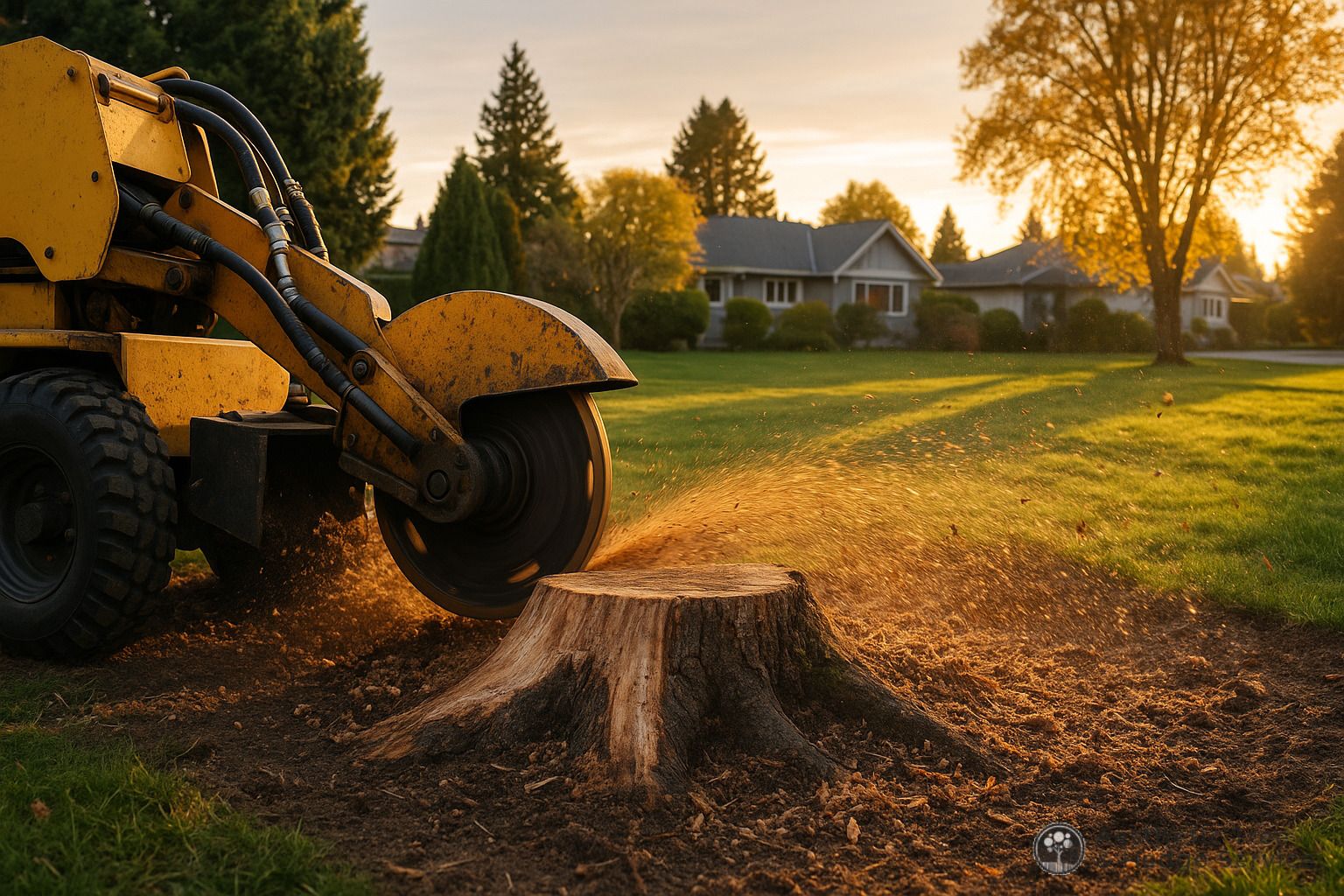
- ISA-certified arborists use commercial grinders — Vermeer, Carlton, and Husqvarna units — to grind stumps 6–12 inches below grade, deep enough to stop regrowth and disrupt surface fungal networks.
- In Vancouver, stump grinding follows permitted tree removal under Private Tree Bylaw No. 9958. The stump grinding itself doesn't require a separate permit in most cases.
---
What Exactly Is Stump Grinding — And How Is It Different from Stump Removal?
This distinction matters. Most homeowners confuse the two.
Stump removal means excavating the entire root ball — roots, trunk base, and all. It's invasive. It disrupts a large section of your soil. It leaves a significant crater that requires backfilling. And for any tree with an established root system, it's a major operation.
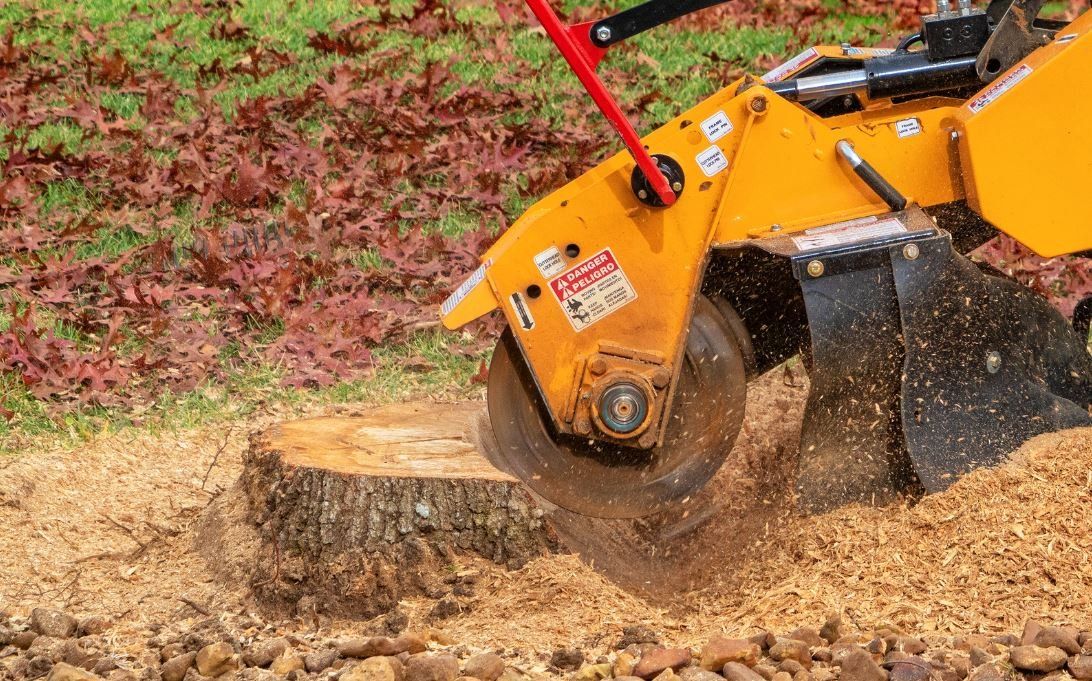
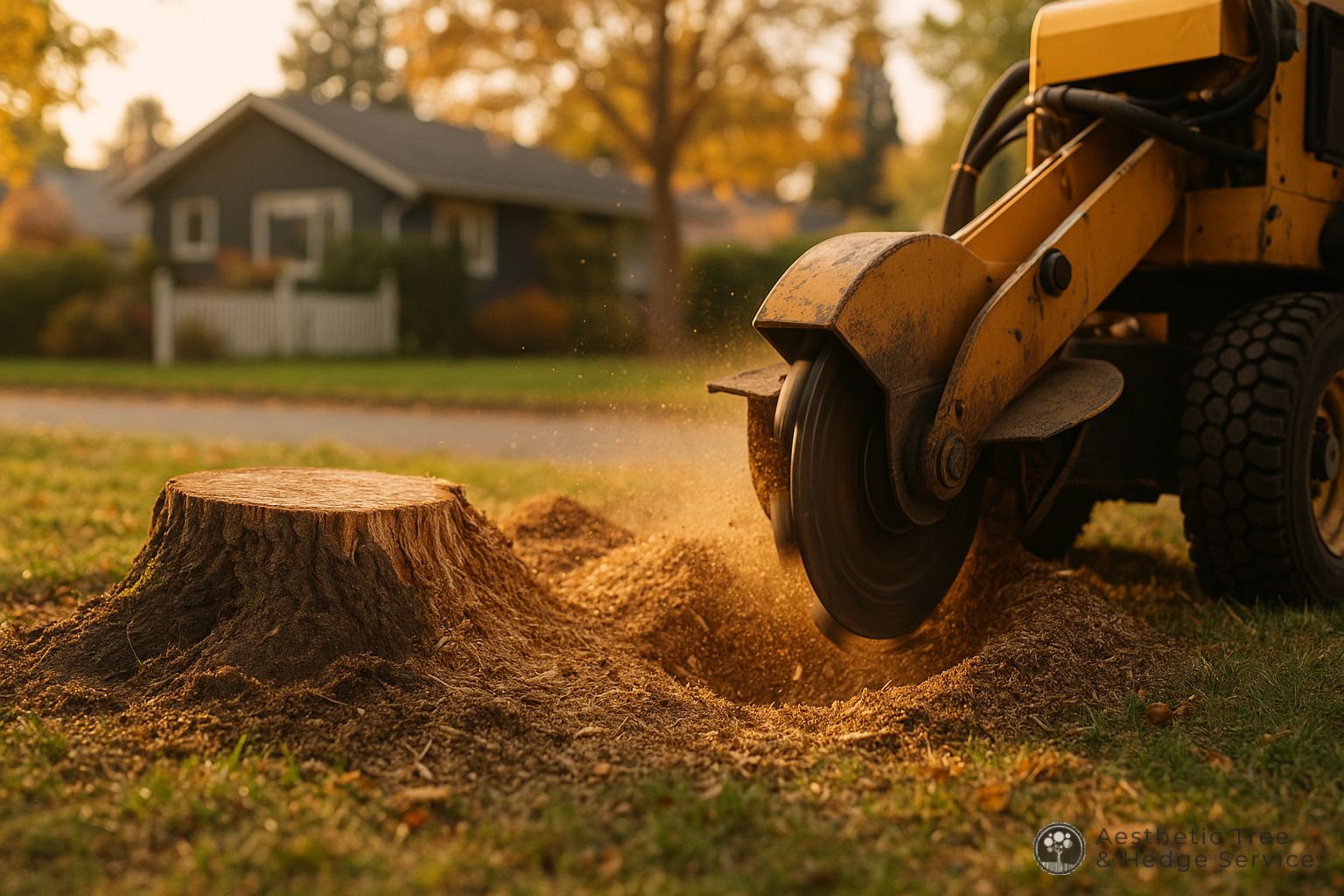
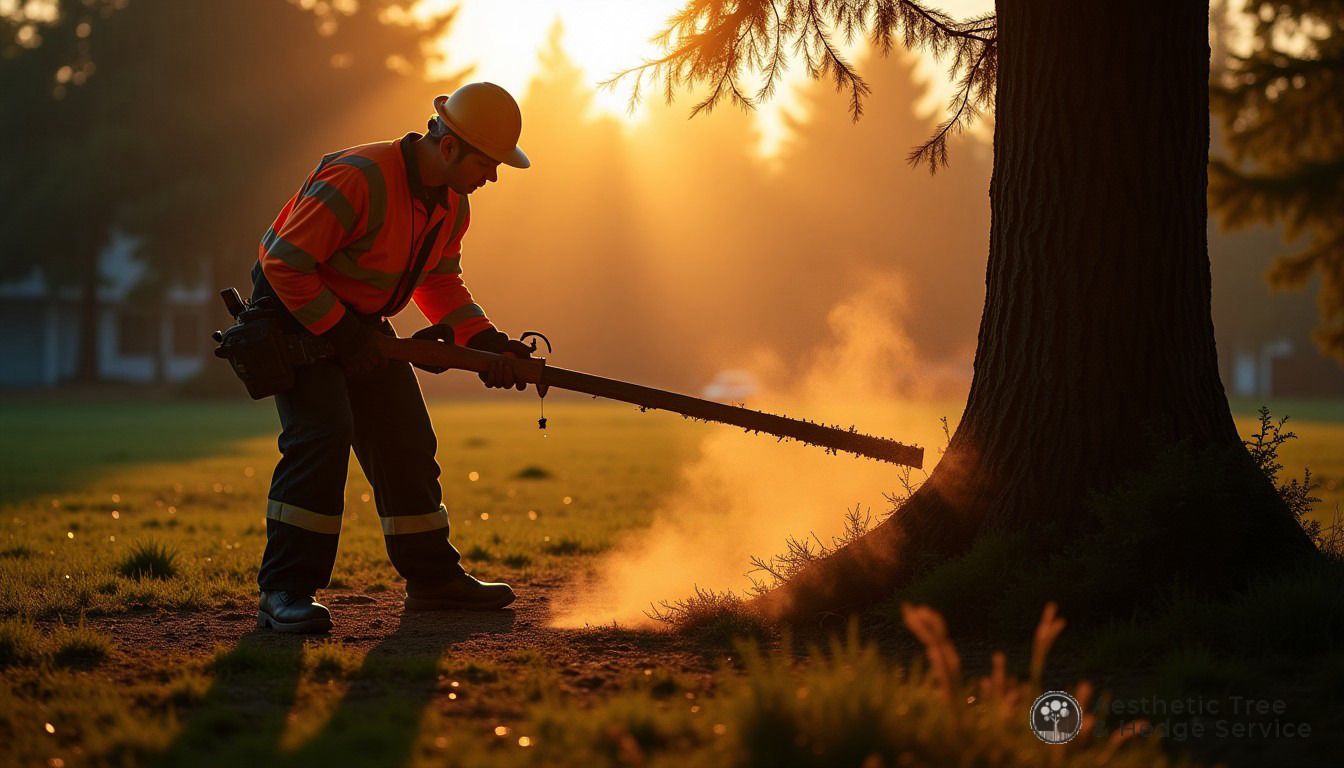
Stump grinding is different. A commercial rotary cutting wheel — fitted with carbide teeth — chips the stump down to 6–12 inches below grade. The lateral roots remain in the ground. They decompose naturally over the following years. The surface is level. The wood chips can be used as mulch or hauled away.
The machines doing this work are purpose-built. ISA-certified arborists in Metro Vancouver use units from Vermeer, Carlton, and Husqvarna. A Vermeer SC252 stump cutter, for example, handles stumps up to 52 inches in diameter and grinds to depth in under 30 minutes for most residential stumps. Carlton stump grinders are known for their precision in tight spaces — useful in Vancouver yards where clearance from fences, foundations, and garden beds is limited.
For most Vancouver homeowners, stump grinding is the right solution. It's faster, less destructive to your soil, and accomplishes what matters: removing the decay source, ending regrowth, and giving you a level yard.
---
Does Leaving a Tree Stump in the Ground Actually Cause Problems?
Yes. Consistently, yes.
The problems start immediately after the tree is cut. The stump begins to decay. In Metro Vancouver's wet climate — the city averages 1,153 mm of annual rainfall — that process accelerates. The wood softens. Fungi colonize. Insects follow.
Three specific categories of damage develop:
**Disease.** Decaying stumps are entry points for root rot fungi. Armillaria ostoyae — the honey fungus — is the primary concern in coastal BC. The BC Ministry of Forests identifies Armillaria root disease as one of the most widespread and damaging root diseases across BC's forests. It spreads through root contact between infected and healthy trees, and through rhizomorphs — black, thread-like fungal structures that travel through soil independently. A stump infected with Armillaria can pass the pathogen to the root systems of healthy trees elsewhere in your yard.
**Pests.** Soft, moist, decaying wood is habitat. Carpenter ants — specifically Camponotus modoc, the Western black carpenter ant endemic to coastal BC — hollow out stumps to establish colonies. Pacific dampwood termites (Zootermopsis angusticollis), the primary termite species in coastal BC, move into wood with moisture content above 20%. A freshly cut stump in a Vancouver winter meets that threshold immediately.
**Safety.** A stump that was 18 inches above grade when the tree was cut becomes a trip hazard within two or three years of settling. At 4–8 inches of exposed height, it's exactly the right dimension to catch a foot and throw someone down. On sloped or uneven Vancouver lots — common in North Vancouver, West Vancouver, and Burnaby's hillside neighbourhoods — this risk increases significantly.
Leaving a stump is not a neutral decision. It's a decision to accept all three of these outcomes.
---
How Does Stump Grinding Stop Disease from Spreading to Healthy Trees?
Armillaria root rot is the primary concern for homeowners across the Lower Mainland.
Armillaria ostoyae spreads two ways. First, through direct root-to-root contact between an infected root system and a healthy neighbouring tree's roots. Second, through rhizomorphs — rope-like fungal structures that grow through soil without needing root contact, extending laterally from an infected stump toward adjacent trees. The BC Ministry of Forests has identified Armillaria as a dominant concern in coastal BC forests, and urban tree populations aren't exempt.
Grinding removes the above-grade stump material and chips the root crown below the soil line. This disrupts the active fungal host. Without a viable wood substrate, rhizomorph growth stalls. The remaining root material decomposes along with the fungal network, rather than spreading it.
Chemical treatment — potassium nitrate and similar accelerants — doesn't address Armillaria. It speeds decomposition, but it doesn't eliminate the fungal network. The root mass remains. The disease risk continues.
Physical grinding is the effective intervention.
If your property has had a large conifer removed — Douglas fir, western red cedar, and Sitka spruce are primary Armillaria hosts in the Lower Mainland — grinding the stump promptly is a direct investment in your remaining trees. For a complete picture of disease risk and your remaining trees' health, an arborist report will assess each tree's structural integrity and disease exposure before any further work is planned.
---
Can a Tree Stump Attract Carpenter Ants and Termites to Your Property?
It does. Reliably, and faster than most homeowners expect.
Carpenter ants require moist, decaying wood to excavate their nesting galleries. They don't eat wood — they live in it. The Western black carpenter ant (Camponotus modoc) is the dominant species in coastal BC. A mature colony contains 3,000–10,000 workers. And a freshly cut, moisture-saturated stump in a Metro Vancouver winter attracts scouts within the first season.
The real risk is what happens next. As a stump colony matures, it sends out satellite colonies — smaller offshoots looking for adjacent wood sources. If your stump is within 10 metres of your home's foundation, deck structure, wood siding, or fence posts, those satellites are looking at your home. Carpenter ant damage to structural wood is expensive. It doesn't announce itself until the colony is well established.
Pacific dampwood termites (Zootermopsis angusticollis) are coastal BC's primary termite species. Unlike subterranean termites, they don't require soil contact. They move directly into wood with high moisture content. A stump qualifies immediately. A dampwood termite colony in a stump is a short step from the wood elements of a deck or outbuilding.
Grinding removes the habitat. Without a moist, soft, accessible stump, neither species has a reason to establish in your yard. It's the most direct form of pest prevention available.
---
Does Stump Grinding Improve Property Value?
Yes — both directly and by removing a visible liability.
Research from the USDA Forest Service shows mature trees add 3–15% to residential property values. Visible decay, stumps, and dead wood signal the opposite: neglect and deferred maintenance. A yard with two or three stumps doesn't show well during a real estate listing. Buyers notice. Inspectors note it. Appraisers factor condition into their assessments.
Beyond listing presentation, stump grinding restores functional yard space. A 30-inch stump with significant surface roots ties up a meaningful area of your lot — space you can't mow, plant over, or use for outdoor furniture, a play structure, or a patio. Grinding returns that square footage to full use.
For homeowners in Richmond, Burnaby, or Coquitlam where lot sizes run smaller than the Gulf Islands acreage fantasies suggest, every square foot of usable outdoor space matters.
The wood chips produced by grinding are also useful, not just waste. A 2–4 inch layer of wood chip mulch over garden beds suppresses weeds, retains moisture, and moderates soil temperature — ideal for the rhododendrons, azaleas, and Japanese maples common in Vancouver gardens. If you want to keep the chips, our mulching service can spread and apply them correctly. If you don't want them, we haul them away.
---
Is Stump Grinding Better Than Chemical Stump Removal?
For most situations in Metro Vancouver, yes — and by a significant margin.
Chemical stump removal uses potassium nitrate to accelerate decomposition. You drill holes, add the chemical, and wait. Small stumps may soften in 4–6 weeks. Large stumps can take months. And throughout that entire period, the stump sits in place — soft, porous, and actively harbouring the moisture that carpenter ants and dampwood termites prefer.
The specific limitations:
- Potassium nitrate does not kill Armillaria or other fungal pathogens. It accelerates decomposition, but the root mass remains as a viable fungal substrate during and after the process.
- The decomposition timeline is unpredictable. Stumps over 30 inches in diameter — common in older Vancouver properties with mature Douglas fir or big-leaf maple — may never fully break down from chemical treatment alone.
- The void left after chemical decomposition is irregular. It settles unevenly over time, creating low spots that collect water and present a different safety hazard.
- Burning the softened stump to speed removal is a common rural approach, but it's not compliant with Metro Vancouver's open burning regulations and is inappropriate in residential areas.
Stump grinding is done in hours. The result is immediate. The surface is level. The wood chips are usable. The yard is functional the same day.
---
How Deep Does Stump Grinding Go — And Does It Remove All the Roots?
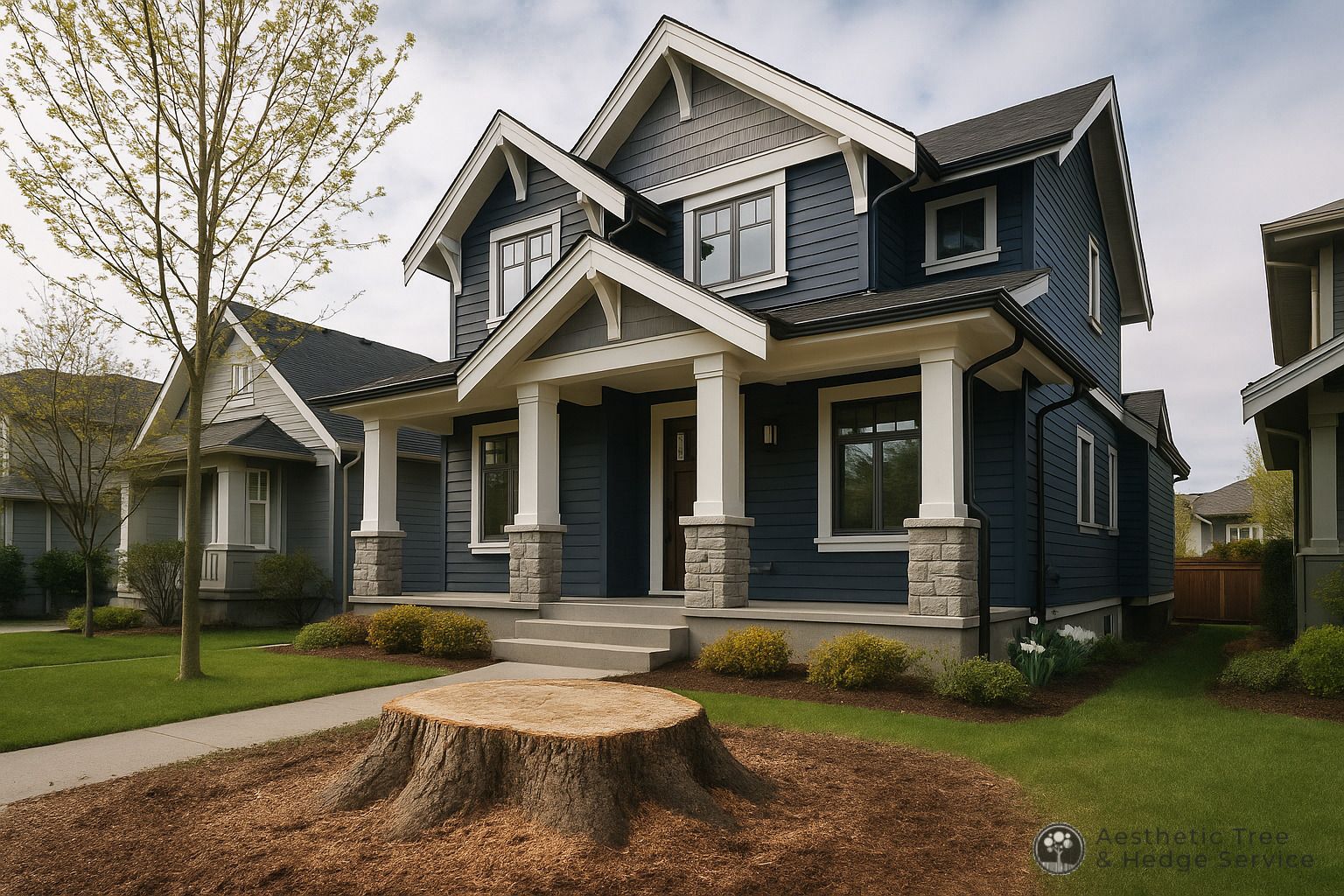
Stump grinding typically goes 6–12 inches below grade. ISA Best Management Practices, developed under ANSI A300 arboricultural standards, establish this depth as effective for preventing regrowth and disrupting surface fungal networks. Some situations — construction preparation, utility installation, or unusually aggressive species with surface-root regrowth potential — warrant going deeper.
Does it remove all the roots? No. And that's not the goal.
The lateral roots — the ones extending outward from the stump's base — remain in the ground. They decompose naturally over 7–10 years. This is normal. For the majority of Vancouver homeowners, it causes no practical problem. You can mow over the area. You can plant groundcover, shrubs, or garden beds. The subsurface roots cause no structural issues as they decompose.
The exception is construction. If you're planning to pour a concrete pad, install a retaining wall, build a fence with post footings, or run underground utilities over a former tree location, the subsurface roots need to be addressed separately. In those situations, your arborist needs to assess the root mass before grinding begins and determine whether additional excavation is required.
For a tree cutting situation where construction is planned on the site afterward, tell your arborist upfront. It changes the scope of the grinding work.
---
Can You Plant a New Tree Where a Stump Was Ground?
Yes — but timing and soil preparation determine whether the new planting succeeds.
After grinding, the area is filled with wood chips and sawdust. This material is high in carbon relative to nitrogen. As soil microbes break it down, they consume available nitrogen from the surrounding soil — temporarily reducing nitrogen availability for anything planted in that zone. Planting directly into fresh grinding chips, without soil amendment, often produces poor establishment results.
The approach that works:
1. Remove or till under the bulk of the wood chip material after grinding. 2. Amend the soil with compost and a balanced nitrogen fertilizer. 3. Wait 6–12 months before planting a new tree in the exact stump location. 4. Have your arborist confirm there's no residual fungal disease in the soil before planting a species susceptible to Armillaria.
If you're ready to plant, our tree planting service assesses soil conditions, recommends species suited to your site, and plants to ANSI A300 standards. In the Lower Mainland, Pacific flowering dogwood, vine maple, and Japanese maple perform well in most residential settings. Douglas fir and big-leaf maple are appropriate for larger lots with deeper, well-draining soil.
---
Do You Need a Permit to Grind a Stump in Vancouver?
In most cases, no — not for the stump grinding itself.
The permit requirement applies to tree removal, not to the grinding that follows. Under the City of Vancouver's Private Tree Bylaw No. 9958, a permit is required to remove a tree with a trunk diameter (DBH) of 20 cm or more, measured at 1.4 metres above grade. Stump grinding is part of normal property cleanup following a permitted removal. It doesn't require a separate application.
Burnaby, North Vancouver, Richmond, and Coquitlam each have parallel tree protection bylaws with similar DBH thresholds — though the specific measurements and requirements vary by municipality. If you're outside Vancouver proper, confirm with your local planning department.
One nuance: if the stump sits adjacent to a protected municipal street tree, or falls within a tree protection zone established in a development permit condition, consult a certified arborist before grinding. A stump's root system can overlap with the roots of a protected adjacent tree. Grinding into that zone without assessment creates liability for damaging a protected tree's root structure.
If you're uncertain whether your situation requires a permit review, an arborist report documents your tree's species, DBH, condition, and removal justification — exactly what any permit application requires.
---
How Does Stump Grinding Fit Into a Full Tree Removal?
Stump grinding is the final step in a complete tree removal in Vancouver. The job isn't finished when the trunk comes down.
The full sequence:
1. Permit obtained where required under Private Tree Bylaw No. 9958 2. Tree felled or sectioned — using conventional or crane tree removal for complex, confined, or high-risk situations 3. Limbs chipped and wood hauled, stacked, or left as requested 4. Stump ground to 6–12 inches below grade 5. Area leveled, wood chips distributed or removed, and surface prepared for seeding, planting, or hardscaping
Skipping step 4 leaves a problem that compounds over time. The stump decays. Disease risk builds. Pests arrive. And three years later, you're paying to grind a stump that's now soft, partially collapsed, and surrounded by the carpenter ant colony that moved in while you waited.
Grinding takes 30–90 minutes for most residential stumps. It's not optional maintenance — it's the completion of the job.
---
What Do Independent Sources Say About Stump Grinding Costs?
Third-party data gives the market range.
According to Angi's 2024 cost report, the average cost to grind a stump in the US is $160–$450 per stump, with most homeowners paying approximately $313. Canadian rates vary by region, stump diameter, site access, and root complexity.
*These figures represent industry averages based on Angi's 2024 consumer cost research from the US market. Actual costs vary by project scope, stump size, access conditions, and site-specific factors. Contact Aesthetic Tree & Hedge Services for a personalized assessment of your specific situation.*
---
Call Aesthetic Tree & Hedge Services
The stump in your yard has a deadline — not yours, the tree's. The longer it sits, the more damage it accumulates: disease spread to your remaining trees, pest colonization, liability from tripping hazards, and square footage you can't use.
Aesthetic Tree & Hedge Services provides ISA-certified stump grinding across Vancouver, Burnaby, North Vancouver, Richmond, and Coquitlam. Our team is WCB registered. Our equipment is commercial-grade — Vermeer and Carlton units that handle any stump diameter, including large-diameter conifers on tight residential lots.
We work to ANSI A300 standards. We know the Private Tree Bylaw inside out. And we've ground stumps on every type of Vancouver property — hillside North Van lots, Richmond agricultural parcels, and dense Kitsilano residential yards where clearance is measured in centimetres.
Call for a free estimate: **(604) 721-7370**
Learn more about our stump grinding service in Vancouver, or call and we'll assess your site the same week.
---
Frequently Asked Questions
**How long does it take to grind a stump?** Most residential stumps take 30–90 minutes. Larger stumps — over 36 inches in diameter — or stumps with significant surface root exposure take longer. Equipment access also affects time: a stump at the end of a narrow side yard takes longer to set up than one in an open front garden. We assess stump size, wood species, and access before every job.
**Can stump grinding damage underground pipes or utilities?** It can, if utilities run directly under the stump. Before grinding, call BC One Call (1-800-474-6886) to have underground utilities located. Our arborists adjust grinding depth and machine angle based on utility proximity. Standard grinding depth is 6–12 inches, which is safe for most residential utility runs — but we always confirm before starting.
**Does stump grinding kill the roots?** It stops regrowth from the stump and disrupts the root crown and surface root structure. It doesn't kill all lateral roots. Those roots decompose naturally over 7–10 years and cause no practical problems in most situations. If you need full root removal — for a concrete pour, hardscaping, or construction — discuss this with your arborist before work begins. The scope changes significantly.
**How soon can I plant grass or a new tree after stump grinding?** For grass: remove or till under the wood chips, backfill with topsoil, compact lightly, and seed. Grass establishes in 3–6 weeks. For a new tree: wait 6–12 months. The wood chip decomposition process temporarily depletes nitrogen in the immediate soil zone. Amend with compost and balanced nitrogen fertilizer first, and confirm with your arborist that no Armillaria contamination is present before planting a susceptible species.
**Is stump grinding noisy? Will it affect my neighbours?** Commercial stump grinders operate at approximately 80–95 decibels — louder than a lawnmower, comparable to a chainsaw at similar distance. For most residential stumps, the active grinding phase lasts 20–45 minutes. Metro Vancouver municipalities generally permit yard work during daytime hours. Our crew completes grinding efficiently and cleans the site before leaving. If you have specific concerns about noise — a home office situation, a newborn, or a neighbour with medical needs — let us know when booking and we'll schedule accordingly.
Found this helpful? Follow our tree care insights directly on Google.
Make us your preferred source on GoogleBefore You Go
Where are you in your tree care journey?
Our Tree Care Services
ISA-certified arborists serving Greater Vancouver
Explore Our Tree Care Services
From expert pruning to safe tree removal, our ISA-certified arborists are ready to help across Greater Vancouver.
View Services